Jump to a question in this guide
- Why does this wiring matter when I am buying?
- What do the wire, ceramic knobs and tubes each do?
- How much old wiring is still there?
- What condition problems or alterations deserve attention?
- Does a three-slot outlet prove the wiring was upgraded?
- Will the house support the way we use electricity?
- Why does attic insulation need electrical coordination?
- What should an electrical assessment answer?
- Could this affect insurance or financing?
- Should retained wiring be repaired, replaced in stages or replaced more widely?
- What else belongs in the rewiring budget?
- What does “updated electrical” actually tell me?
- What records should come with the completed work?
- How do I decide whether this house and the work fit?
- Knob-and-tube describes wiring in the house, not the age of its electrical panel. A panel upgrade can leave older circuits in place.
- Learn the separate jobs of the conductor covering, ceramic knobs and ceramic tubes. Do not touch or disturb them during a viewing.
- A qualified electrical assessment, a written insurer answer and a realistic work plan belong together before you rely on the purchase.
- Wiring work can involve access and finish repairs as well as electrical parts. Insulation changes need coordination where old wiring may remain.
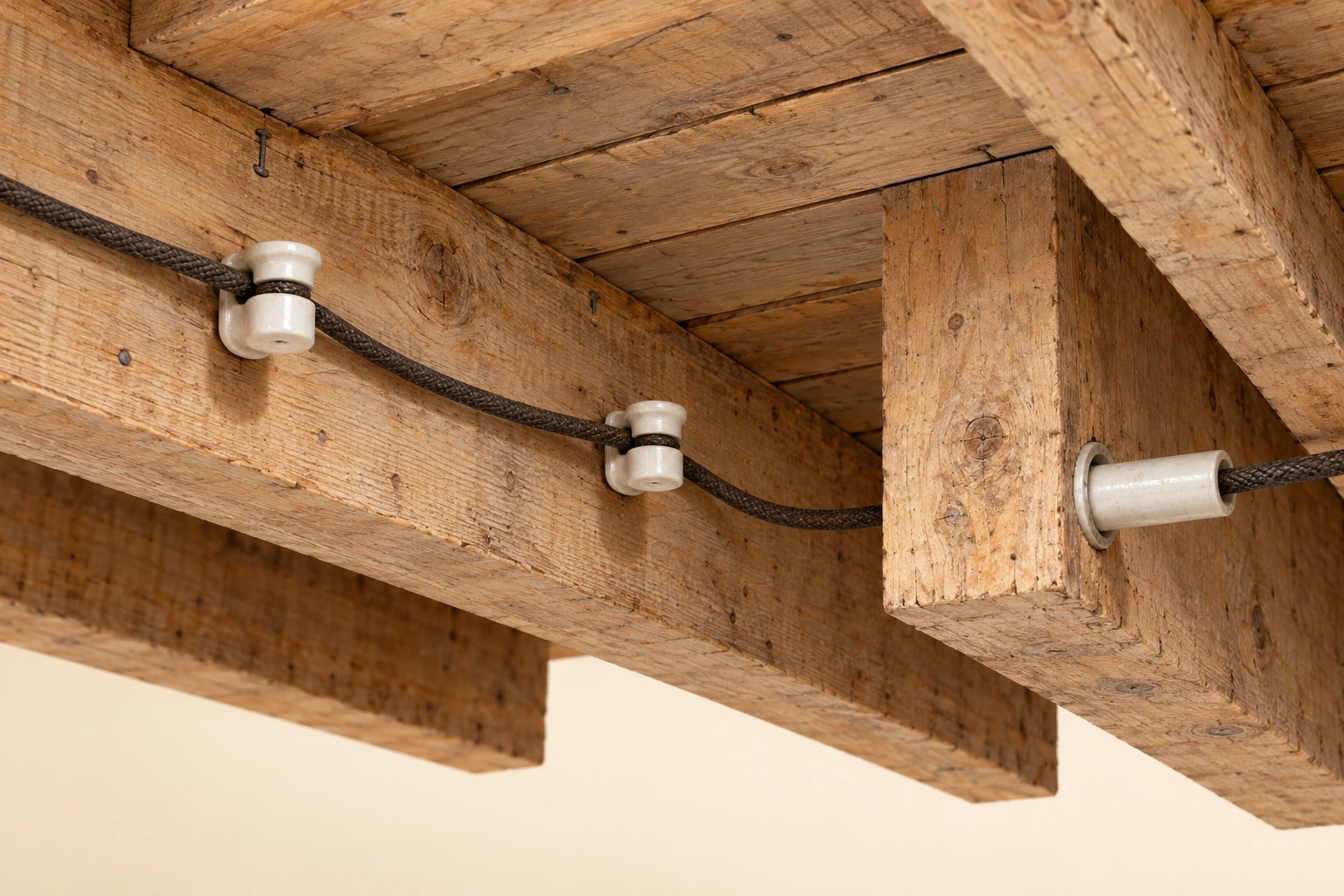
The ceramic knob supports an insulated wire away from the wood. The ceramic tube protects its passage through a timber member. The conductor still has its own insulating covering; the white ceramic does not replace it.
About this illustration
Original teaching illustration. The actual equipment and its instructions determine the applicable details.
10 picture lessons appear beside the questions in this guide. Use them to understand the explanation, then consider what it means for your home.
Why does this wiring matter when I am buying?
You may find a beautiful older house with a newer electrical panel, renovated rooms and a listing that says “updated electrical”. It is natural to assume that means the wiring was replaced. It may mean something smaller. The panel, wiring serving the rooms and visible switches or outlets can have different histories.
That matters to the purchase because wiring condition, future renovation and insurance may all depend on what remains. Before relying on an update claim, ask what was actually changed. A panel invoice is useful, but it is not automatically a whole-house rewiring record.
Knob-and-tube is a historic wiring method. Separate insulated conductors were supported on ceramic knobs and passed through timber members in ceramic tubes. The new pictures show those parts clearly so the phrase means more than “some old electrical thing in the basement”. An older house may contain several generations of wiring.
The useful buying question is not whether every house with this label should be accepted or rejected. It is whether you can understand this house’s wiring, required work and remaining uncertainty well enough to make the purchase fit your household. That needs a competent assessment of the actual installation.
The primary technical examples here are from Ontario’s Electrical Safety Authority, including a June2019 notice, alongside Canadian NRCan guidance. Ontario code-era statements are not current nationwide instructions. Ask the current electrical authority and properly qualified professional about your property’s jurisdiction; the drawings do not assess a house for sale.
What do the wire, ceramic knobs and tubes each do?
The conductor is the metal part carrying electrical current. It has its own insulating covering. The ceramic knob supports the covered conductor away from a structural surface; the tube protects its passage through a timber member. These jobs are separate. An intact white support cannot tell you that the wire’s covering is intact.
Look at the whole framing view, then the close-ups. In this historic method the conductors are separate, rather than enclosed together in the modern-looking cable many buyers recognize. One route may run along the side of a joist while another passes through a member inside a tube. The illustrations identify materials and jobs, not dimensions or a wiring route to copy.
Electrical current needs a complete path through the supplied equipment and back to its source. The historic wiring method arranged that path with its own conductors. It did not include the modern equipment bonding conductor buyers may expect from newer branch wiring. Bonding and protective devices therefore deserve their own question in an assessment.
A white ceramic remnant can remain after electrical changes. Do not assume it is live, abandoned or safe to touch. A qualified professional must identify its status and the surrounding wiring. Keep your own observation simple: where it was seen, what was accessible and what the seller’s records say.
You are learning the vocabulary so you can understand the report and recognize the parts. Do not tug on a wire, remove a receptacle cover or follow a route into a confined or unsafe space. A historic assembly picture is not permission to make an energized investigation.
What knob-and-tube wiring looks like
The ceramic knob supports an insulated wire away from the wood. The ceramic tube protects its passage through a timber member. The conductor still has its own insulating covering; the white ceramic does not replace it.
Choose a part name to highlight its explanation below.
- Insulated conductor
The individual wire has its own insulating covering.
- Ceramic knob
The knob supports the covered conductor away from the wood.
- Ceramic tube
The tube protects passage through the timber member.
About this illustration
Original teaching illustration. The actual equipment and its instructions determine the applicable details.
The knob, tube and wire covering do different jobs
These are different materials doing different work: the conductor’s covering insulates it, the knob supports it and the tube protects a crossing through wood. A ceramic remnant alone does not tell you whether wiring is still connected.
Choose a part name to highlight its explanation below.

- Ceramic knob
Supports the covered conductor away from the timber.
- Ceramic tube
Protects the conductor where it passes through a wood member.
- Wire covering
Insulates the conductor itself; intact ceramic is a different observation.
About this illustration
Original teaching illustration. The actual equipment and its instructions determine the applicable details.
How much old wiring is still there?
Begin with the seller’s records: invoices, permit or authority records where applicable, contractor details and the stated areas of work. Ask what “rewired downstairs” meant. It might describe accessible basement portions, certain circuits or a broader project. Until the scope is clear, keep it as the seller’s description rather than a conclusion about the upper floors.
ESA’s contractor transcript describes a useful trap: newer exposed wiring may have been installed as far as the point where a route disappears into a wall. The concealed continuation can still need investigation. A clean basement view is therefore not enough to settle the whole house.
The panel-and-wall cutaway makes that distinction visible. The closed newer panel is one piece of equipment; the separately shown old segment disappears behind a finish. No invented connection is drawn between them. Ask the electrical professional how they will determine what still serves the rooms and what cannot be determined with available access.
A useful report distinguishes wiring that was identified, remnants established to be disconnected and concealed portions that remain unresolved. It should also say what was sampled rather than mapped throughout the house. Do not extend a finding from one accessible location to every room when speaking with the insurer or lender.
If more access is needed, the owner’s permission and the method of reinstatement may have to be arranged. Do not energize unknown circuits, open a panel or pull conductors to resolve the question yourself. If a consequential route cannot be understood before your decision, include that uncertainty in the purchase discussion rather than assigning it an optimistic result.
A newer panel does not prove the walls were rewired
The panel and the circuits serving the rooms are different parts of an electrical upgrade. A newer closed panel can coexist with retained older wiring. Ask which circuits were replaced and what still disappears behind finishes.
Choose a part name to highlight its explanation below.
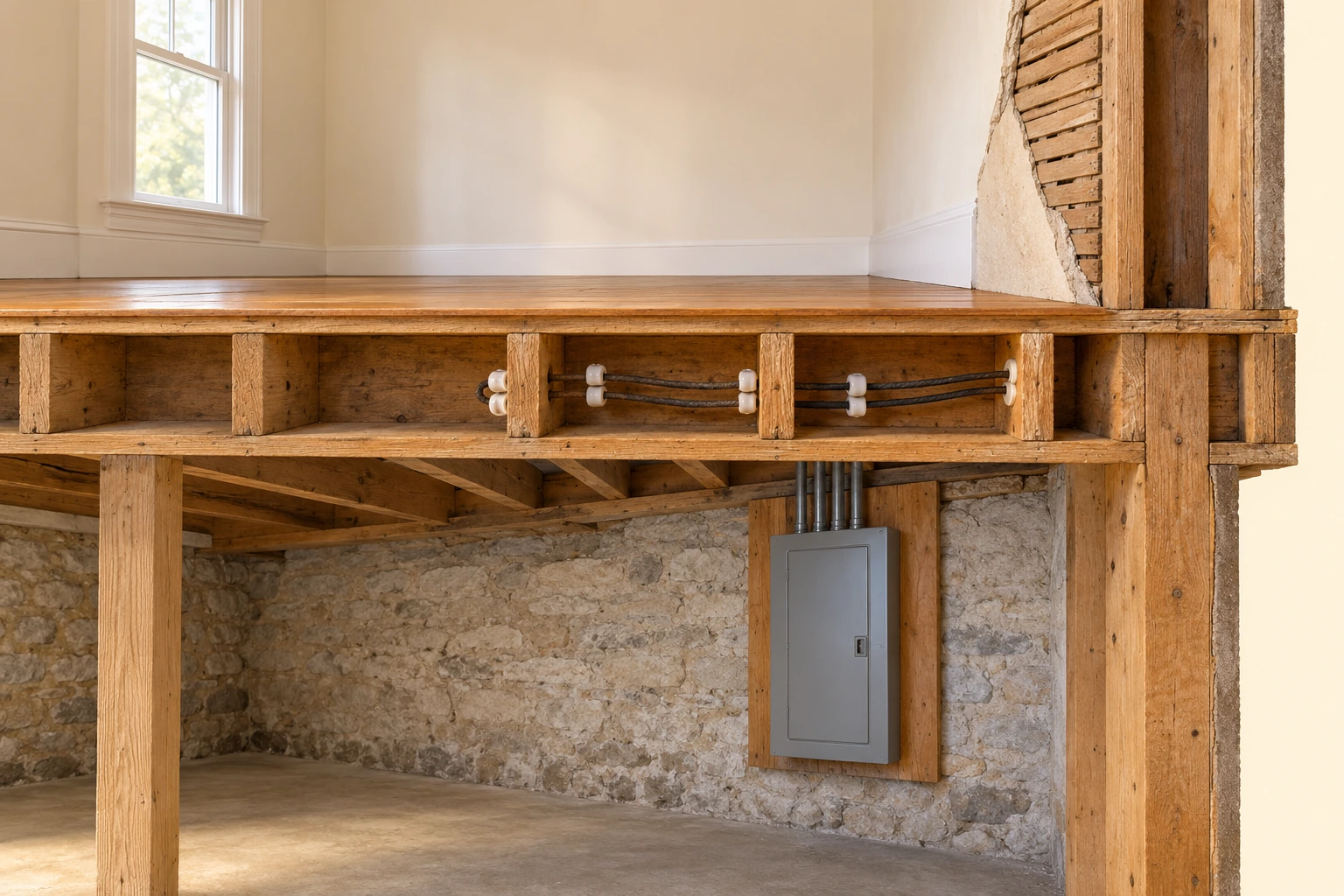
- Closed newer panel
A panel replacement is a different scope from replacing circuits throughout rooms.
- Retained old route
This separate illustrated segment remains visible in the floor construction. No connection to the panel is drawn.
- Finished space
Finishes hide the continuation; ask which circuits the actual work covered.
About this illustration
Original teaching illustration. The actual equipment and its instructions determine the applicable details.
One visible length is not a whole-house map
A conceptual section separates an assessed location from an unknown continuation.
Choose a part name to highlight its explanation below.
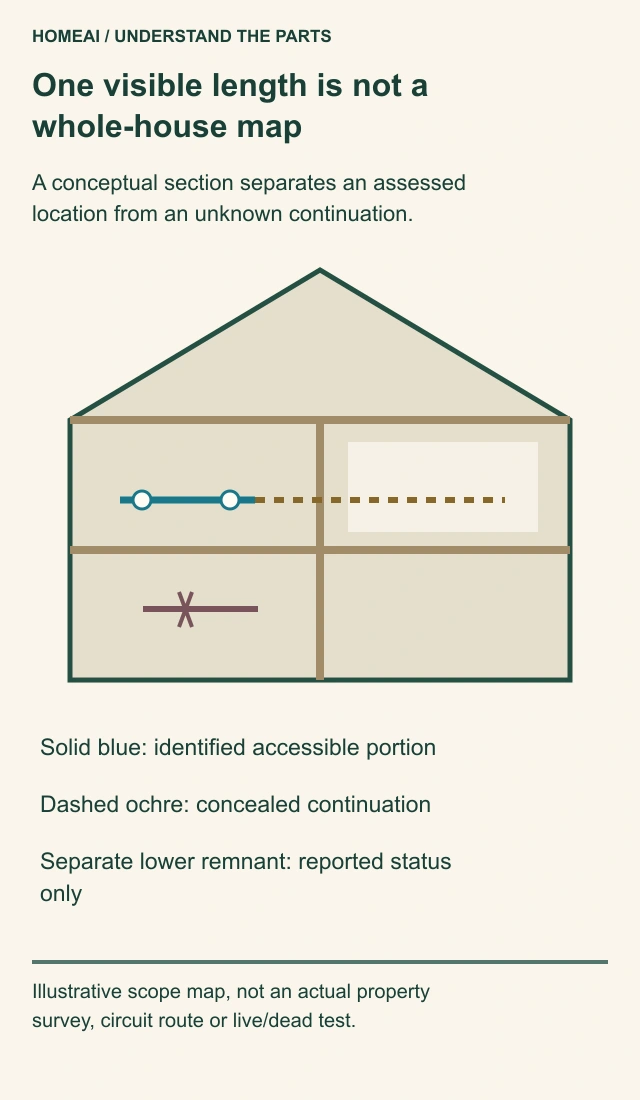
- Identified accessible portion
The location the professional could assess.
- Concealed continuation
A route disappearing behind a finish remains unresolved.
- Reported disconnected remnant
Use that description only when the professional established it.
- Ask about the report
What remains outside the assessed scope?
About this illustration
Illustrative scope map, not an actual property survey, circuit route or live/dead test.
One visible length is not a whole-house map
A conceptual section separates an assessed location from an unknown continuation.
- Identified accessible portion
- The location the professional could assess.
- Concealed continuation
- A route disappearing behind a finish remains unresolved.
- Reported disconnected remnant
- Use that description only when the professional established it.
- Ask about the report
- What remains outside the assessed scope?
Read all the diagram text
- HOMEAI / UNDERSTAND THE PARTS
- One visible length is not a
- whole-house map
- A conceptual section separates an assessed
- location from an unknown continuation.
- Solid blue: identified accessible portion
- Dashed ochre: concealed continuation
- Separate lower remnant: reported status
- only
- Illustrative scope map, not an actual property
- survey, circuit route or live/dead test.
What condition problems or alterations deserve attention?
The wiring method and the condition of a particular installation are different questions. A house’s age cannot tell you whether its wire covering has deteriorated, whether exposed sections were damaged or how later alterations were made. Those are findings for the actual assessment.
The damaged-covering close-up shows a specific concern: the insulation around a conductor has cracked or frayed even though the ceramic support remains whole. It helps you recognize why a professional looks at the wire, not only the white knobs. Do not touch a similar area or bend the covering to see whether it crumbles.
Later changes matter because a room can look modern while retaining some older supply wiring. A kitchen renovation invoice might cover a lighting alteration or a new device rather than every circuit serving the space. Ask how the electrical part of the renovation was described and documented.
ESA’s contractor discussion also describes exposed basement wiring being damaged by stored materials. Do not treat joist spaces above old conductors as a convenient shelf for spare trim or other belongings. If something may be resting against wiring, arrange appropriate advice rather than shifting it during a viewing.
Avoid both blanket conclusions: “all old wiring is dangerous” and “it has worked for decades, so it is fine”. A useful professional report connects observed conditions and alterations with a recommendation, while explaining where access or information was missing. That is more useful than an age label or a reassuring photograph.
An intact ceramic support can sit beside damaged wire covering
The wire’s own covering is damaged in this illustration, even though the ceramic support is intact. Do not touch or disturb a similar concern during a viewing. Give its location to the qualified electrical professional assessing the house.
Choose a part name to highlight its explanation below.
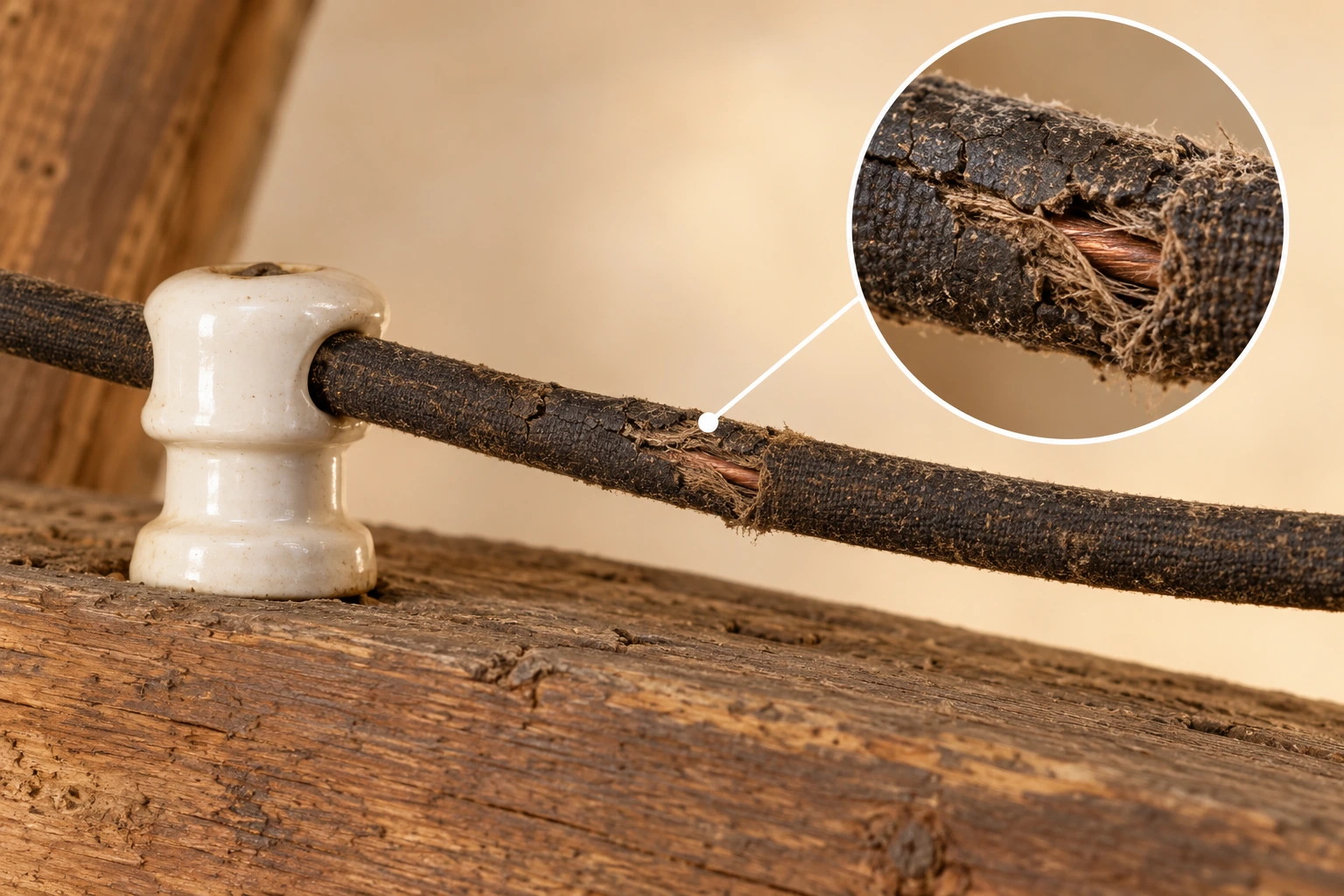
- Damaged covering
The split and frayed outer material exposes a small metal area in this example.
- Ceramic support
Its intact appearance does not repair the damaged conductor covering.
- Safe viewing
Do not touch or disturb similar wiring; give its location to the electrical professional.
About this illustration
Original teaching illustration. The actual equipment and its instructions determine the applicable details.
Does a three-slot outlet prove the wiring was upgraded?
No. The visible face tells you which openings are present. It does not show the connections behind the wall or whether an appropriate bonding path exists. The two-slot/three-slot comparison deliberately keeps both covers closed so the visible difference is not mistaken for an inspection of the wiring.
The original historic arrangement did not have the equipment bonding conductor used with newer systems. A later three-slot receptacle can therefore raise a question about the concealed arrangement rather than answer it. Ask the electrical professional to identify what protection and connection actually exist.
Equipment bonding intentionally connects relevant metal parts that do not normally carry operating current into the protective electrical arrangement. It helps limit voltage differences between those parts and provides a low-resistance route for fault current back toward the source so a protective device can operate. That is the job of the intended connection; a buyer still needs qualified assessment to establish that the actual route is present and sound.
A ground-fault circuit interrupter, or GFCI, has a different protective job. CCOHS explains that it detects a loss of current in a circuit and interrupts the supply. It is an additional protective measure, not a replacement for safe practices. It does not create the missing equipment-bonding connection or replace all the older circuit wiring. ESA’s historical notice makes that distinction explicit.
The historical Ontario notice discusses these distinctions alongside code-era options. This guide does not turn it into a current repair recipe. Device replacement, adding a protective function and replacing a circuit are different possible scopes; the qualified professional and current local requirements determine the appropriate work.
Do not ask a seller or agent to remove a cover or make an energized test to reassure you. A plug-in tester demonstration is not a substitute for a properly scoped assessment of the actual arrangement. Ask what was assessed, who did it and what the result means for the circuit behind that device.
A three-slot receptacle face does not prove the hidden protective path
Three openings describe the face you can see; they do not prove the protective connection behind it. Ask the electrical professional about the actual bonding and protective arrangement rather than accepting a newer cover as proof that the circuit was replaced.
Choose a part name to highlight its explanation below.
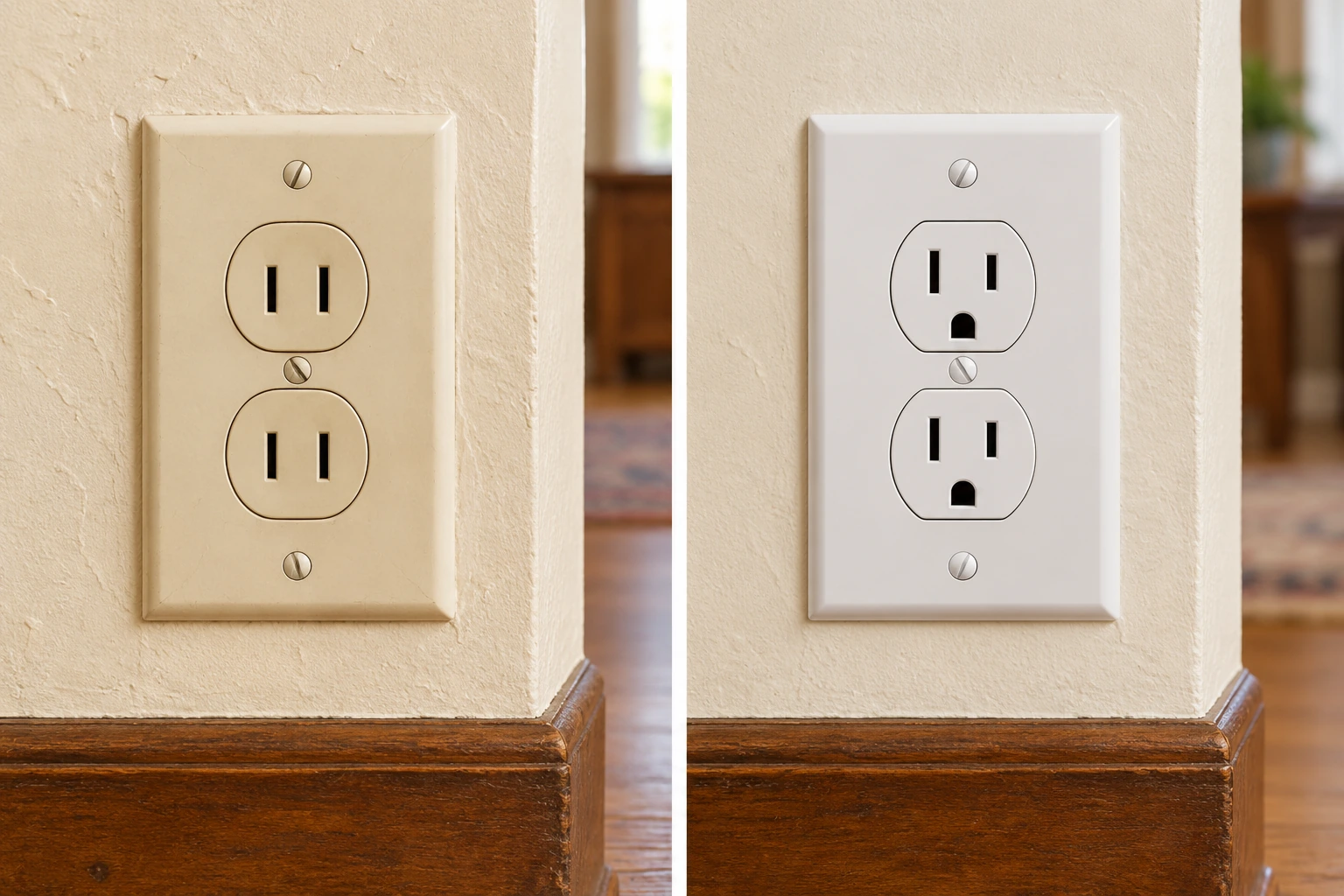
- Two-slot face
Two visible openings identify the face, not the complete concealed circuit.
- Three-slot face
A third opening does not prove the protective connection behind the wall.
- Electrical assessment
Ask about actual bonding, ground-fault protection and circuit work as separate jobs.
About this illustration
Original teaching illustration. The actual equipment and its instructions determine the applicable details.
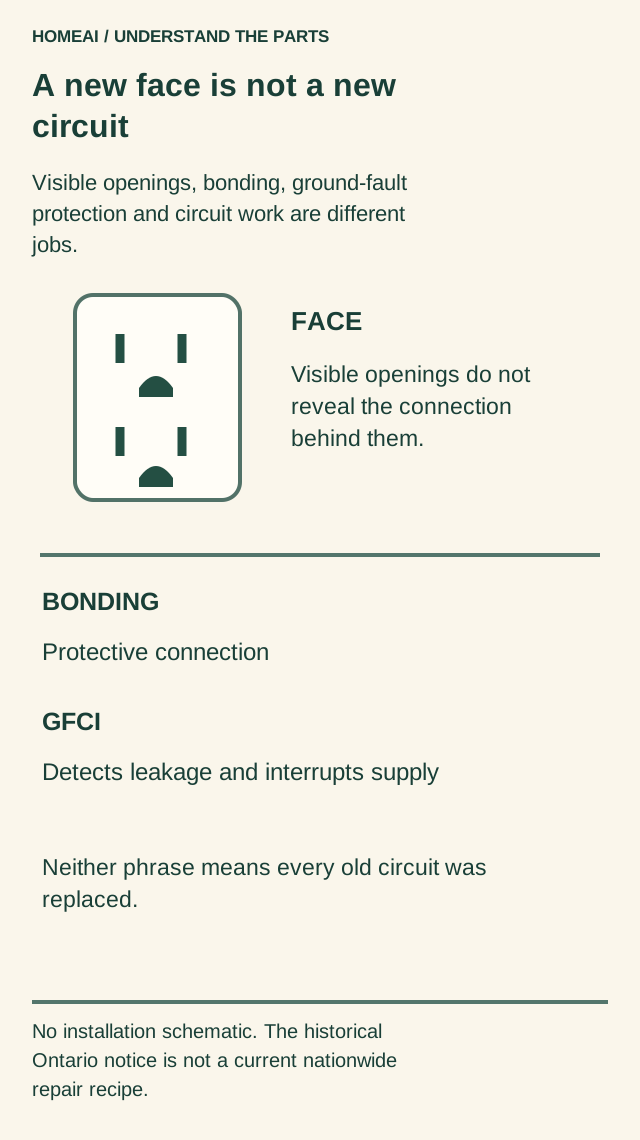
A new face is not a new circuit
Visible openings, bonding, ground-fault protection and circuit work are different jobs.
Choose a part name to highlight its explanation below.
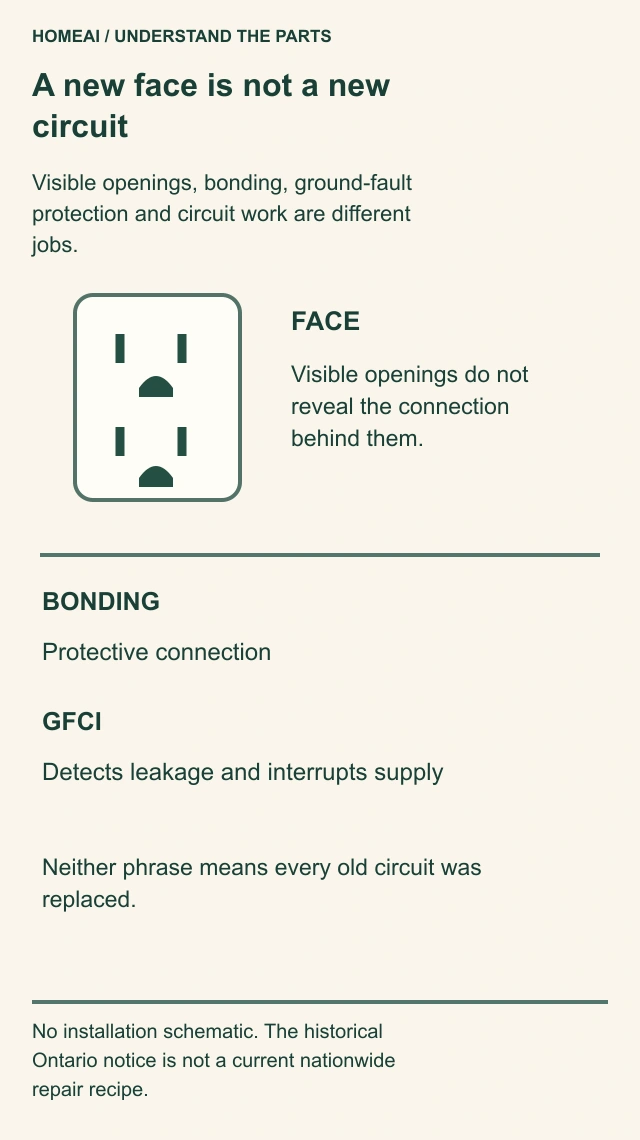
- Receptacle face
The openings visible from the room.
- Bonding
The actual protective electrical connection, assessed professionally.
- GFCI
A separate protective function; it does not add a bonding conductor.
- Circuit replacement
A defined wiring project, not a change of faceplate.
About this illustration
No installation schematic. The historical Ontario notice is not a current nationwide repair recipe.
A new face is not a new circuit
Visible openings, bonding, ground-fault protection and circuit work are different jobs.
- Receptacle face
- The openings visible from the room.
- Bonding
- The actual protective electrical connection, assessed professionally.
- GFCI
- A separate protective function; it does not add a bonding conductor.
- Circuit replacement
- A defined wiring project, not a change of faceplate.
Read all the diagram text
- HOMEAI / UNDERSTAND THE PARTS
- A new face is not a new
- circuit
- Visible openings, bonding, ground-fault
- protection and circuit work are different
- jobs.
- FACE
- Visible openings do not
- reveal the connection
- behind them.
- BONDING
- Protective connection
- GFCI
- Detects leakage and interrupts supply
- Neither phrase means every old circuit was
- replaced.
- No installation schematic. The historical
- Ontario notice is not a current nationwide
- repair recipe.
Will the house support the way we use electricity?
List the uses that matter to your household: kitchen appliances, computers, laundry, heating equipment and any foreseeable new project. An older arrangement may serve more activities from one circuit than you expect. A newer panel label does not tell you which rooms share a retained circuit.
ESA’s transcript describes inappropriate changes made when older circuits no longer met occupants’ demands. The lesson is to assess the actual circuits and intended loads together. Do not change fuse or breaker ratings, rely on permanent extension-cord arrangements or keep recreating a trip to see what will run.
Ask which circuits serve the areas important to you and what work would be required. A service or panel upgrade can be one part of an improvement while older room wiring remains. Keep the incoming service, distribution equipment and branch circuits—the wiring serving connected loads—separate in the conversation.
A major future use, such as a renovation or vehicle charging, may need its own feasibility and load assessment. If it is essential to your purchase, obtain that advice before treating it as an assured feature. The home you can use today and the home you plan to create may require different electrical work.
Why does attic insulation need electrical coordination?
An insulation upgrade is not just a question of adding more material. NRCan warns against insulation contacting old knob-and-tube wiring. If that wiring may remain in the area, the electrical and insulation questions need to be considered together before the work is ordered.
The attic illustration shows that physical relationship: recognizable old conductors and ceramic supports meet loose-fill insulation. It is an example of a condition needing advice, not an approved assembly or a suggested clearance. Do not move insulation, reach into a cavity or disturb old materials to reproduce the view.
Ask which areas will be insulated, how the wiring there was assessed and what electrical work is needed first. A new panel elsewhere in the building does not settle the attic. Likewise, an insulation receipt does not explain the condition or extent of wiring that the receipt never covered.
Coordinate access and the relevant professional scopes. There can also be fall and material-disturbance hazards in an old attic. If safe access is unavailable, keep that limitation in the plan rather than treating an unvisited space as clear. The right response depends on the actual installation and current local requirements.
Old wiring and new insulation need coordinated assessment
Insulation work and old wiring cannot be planned as unrelated jobs. NRCan warns against insulation contacting old knob-and-tube wiring. If this relationship may be present, arrange coordinated advice before adding or disturbing insulation; do not uncover it yourself during a viewing.
Choose a part name to highlight its explanation below.

- Loose-fill insulation
The illustrative fill reaches the old conductors at the right.
- Old conductors
Their relationship with added insulation needs professional attention.
- Coordinated work
Ask how the electrical and insulation assessments fit together before adding or disturbing material.
About this illustration
Original teaching illustration. The actual equipment and its instructions determine the applicable details.
What should an electrical assessment answer?
Tell the professional that you are considering a purchase and what decisions depend on the report. In Ontario, ESA directs consumers to a Licensed Electrical Contractor. In another jurisdiction, ask the current electrical authority which qualifications and process apply. A general home inspection and a focused electrical assessment are different scopes.
Ask for the old wiring that was identified, the condition or alteration concerns found, the recommended response and the places that remain unresolved. The report should make clear whether a conclusion applies to an accessible sample, particular circuits or a broader mapped area.
A helpful explanation also separates an immediate concern from future modernization. What work is needed for the stated problem? What is suggested for the household’s planned use? What additional access would be needed before either can be priced or assessed? Those questions are more useful than asking whether the house simply “passed”.
Agree on access before expecting a short visit to answer concealed questions. The seller may need to authorize investigation, and finish protection or repair may need to be discussed. If there is not enough time for an adequate assessment, discuss the transaction options with your adviser. A deadline does not complete an investigation.
The closed panel stays closed during your own viewing. You can identify its location and ask for records without opening it. Covers, test equipment and electrical work belong with the properly qualified people and their safe work arrangements.
Could this affect insurance or financing?
Raise the wiring question early with the insurer. ESA’s Ontario guidance notes that some insurers may decline coverage or require replacement. That does not mean every insurer has one universal rule. You need a response for this property, its actual assessment and the work sequence you propose.
Give the insurer the report, including unresolved areas, rather than shortening it to “the wiring passed”. Ask what documentation it needs, whether conditions apply and when work would need to be completed. Keep the written response and coordinate consequential requirements with your purchase adviser.
Technical assessment and insurance acceptance serve different purposes. An insurer willing to cover the house has not inspected every hidden conductor. A refusal does not diagnose every circuit. The buying plan needs both an understood installation and workable coverage.
Include intended occupancy and work in the conversation. Rewiring while the house is occupied can involve a different sequence from completing work while it is vacant. Ask the lender about any relevant financing requirements too. Do not wait until possession to discover that the technical, insurance and transaction timetables cannot fit together.
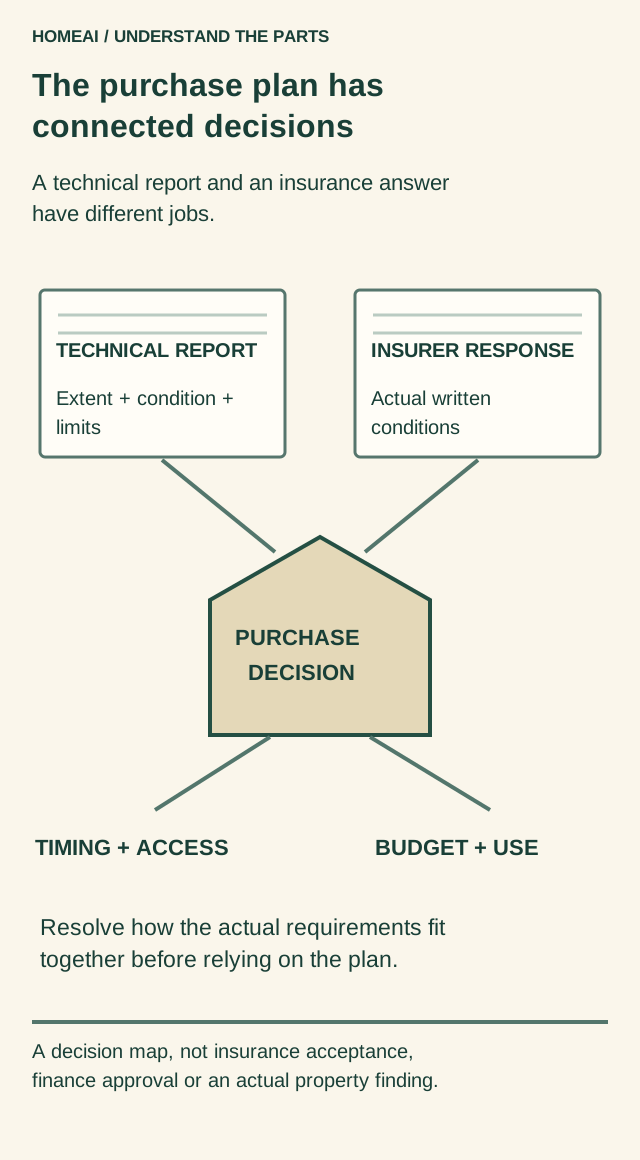
The purchase plan has connected decisions
A technical report and an insurance answer have different jobs.
Choose a part name to highlight its explanation below.
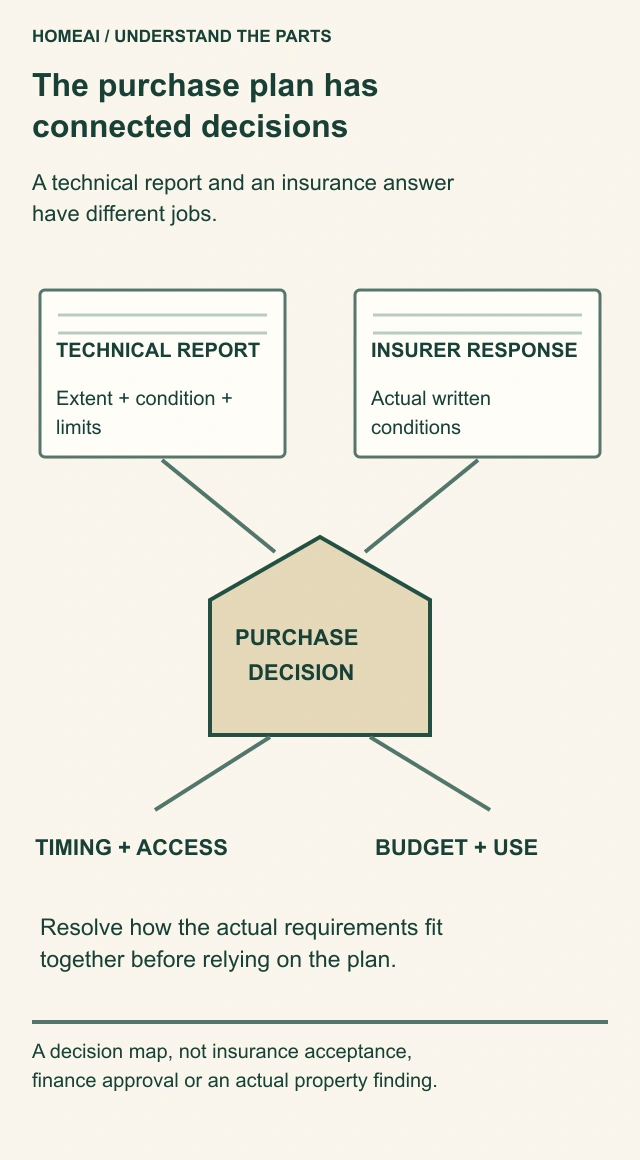
- Electrical professional
Actual extent, condition, work recommendations and assessment limits.
- Insurer
The actual property, report and proposed sequence, with written conditions.
- Purchase adviser or lender
Timing and transaction requirements.
- Buyer
Budget, access and occupancy need to fit the whole plan.
About this illustration
A decision map, not insurance acceptance, finance approval or an actual property finding.
The purchase plan has connected decisions
A technical report and an insurance answer have different jobs.
- Electrical professional
- Actual extent, condition, work recommendations and assessment limits.
- Insurer
- The actual property, report and proposed sequence, with written conditions.
- Purchase adviser or lender
- Timing and transaction requirements.
- Buyer
- Budget, access and occupancy need to fit the whole plan.
Read all the diagram text
- HOMEAI / UNDERSTAND THE PARTS
- The purchase plan has
- connected decisions
- A technical report and an insurance answer
- have different jobs.
- TECHNICAL REPORT
- Extent + condition +
- limits
- INSURER RESPONSE
- Actual written
- conditions
- PURCHASE
- DECISION
- TIMING + ACCESS
- BUDGET + USE
- Resolve how the actual requirements fit
- together before relying on the plan.
- A decision map, not insurance acceptance,
- finance approval or an actual property finding.
Should retained wiring be repaired, replaced in stages or replaced more widely?
The appropriate response depends on the actual findings and your plans. Ask the professional what each proposed option leaves in place. Investigation, a defined repair, a staged project and broader replacement answer different questions; the wiring label alone does not choose among them.
A staged plan can reduce the immediate disruption, but it needs a coherent stopping point. Which circuits remain, how can the household use the property in the meantime and what does the insurer require? Ask whether a later stage would reopen finishes completed in the first one.
Wider replacement also needs a defined result. Which rooms, circuits and devices are covered? How will the completed work be verified and documented? A proposal titled “remove knob-and-tube” is not enough if nobody explains how the contractor will determine what remains.
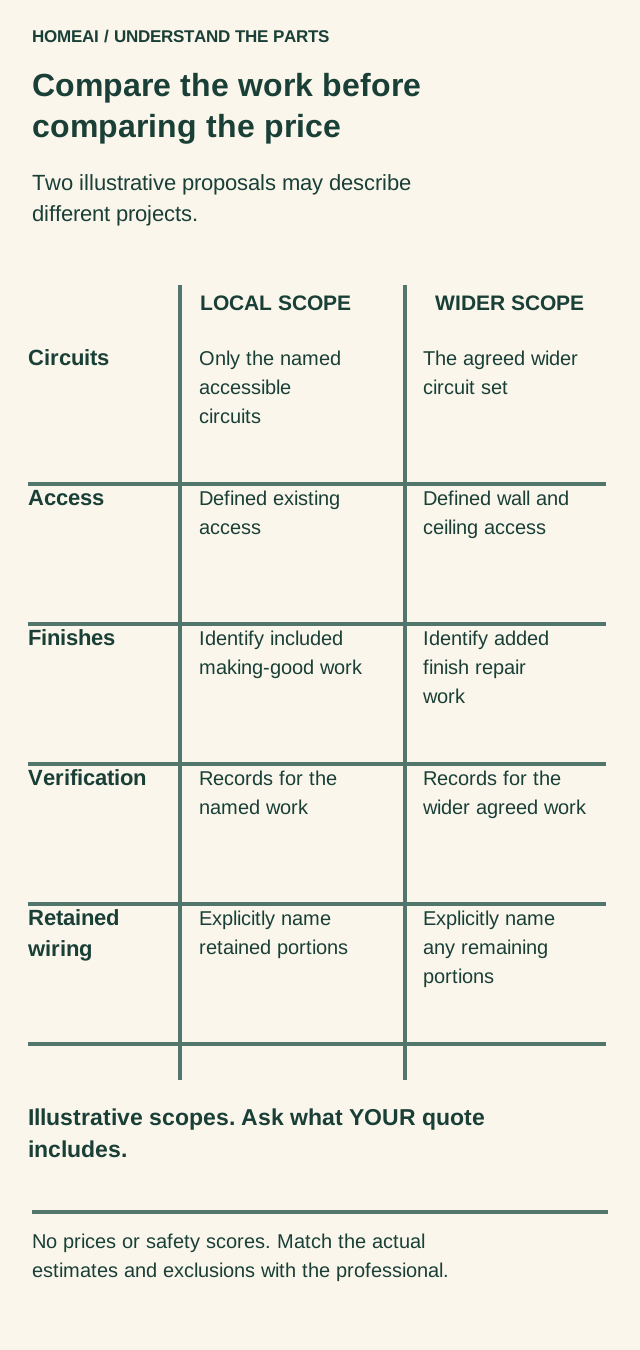
Do not compare prices until the results are comparable. Accessible basement work and a wider project serving upper rooms are not competing prices for one identical job. The tailored scope comparison beside the next chapter helps you check the inclusions before treating a lower total as a bargain.
Another property remains an option if the work, access, uncertainty or disruption does not fit. A discount cannot reserve a contractor, secure insurer acceptance or establish the condition behind a wall. Compare the whole undertaking rather than one electrical price line.
What else belongs in the rewiring budget?
The electrical parts are only part of the project. Ask how the contractor expects to reach the circuits and devices, who makes openings, how occupied areas are protected and who repairs finishes afterward. Electrical work and wall or ceiling reinstatement may be priced by different people.
The comparison figure uses illustrative scopes rather than invented market prices. Its rows ask about circuits, access, finish repairs, verification and retained wiring. Two estimates can use the same “rewiring” label while one excludes several of those tasks. Get those differences explained before using the figures in your purchase budget.
Older finishes can introduce material-disturbance questions. ESA’s contractor transcript specifically notes possible asbestos when opening older walls; that does not identify asbestos in this house. Obtain appropriate advice about the actual materials before intrusive work. Do not sample or open suspect finishes during a viewing.
Ask how concealed discoveries and changes would be handled and authorized. A financial reserve is money set aside for uncertainty, not a promise that every unknown will cost less than it. A substantial unresolved condition may need further investigation before it belongs in a workable budget.
Treat timing as part of the scope. Confirm who can perform the work, what approvals or inspections apply and which areas may be unavailable. A seller’s assurance that a contractor can start immediately is not the contractor’s confirmed programme. Make the plan fit the actual purchase, occupancy and insurer requirements.
Compare the work before comparing the price
Two illustrative proposals may describe different projects.
Choose a part name to highlight its explanation below.
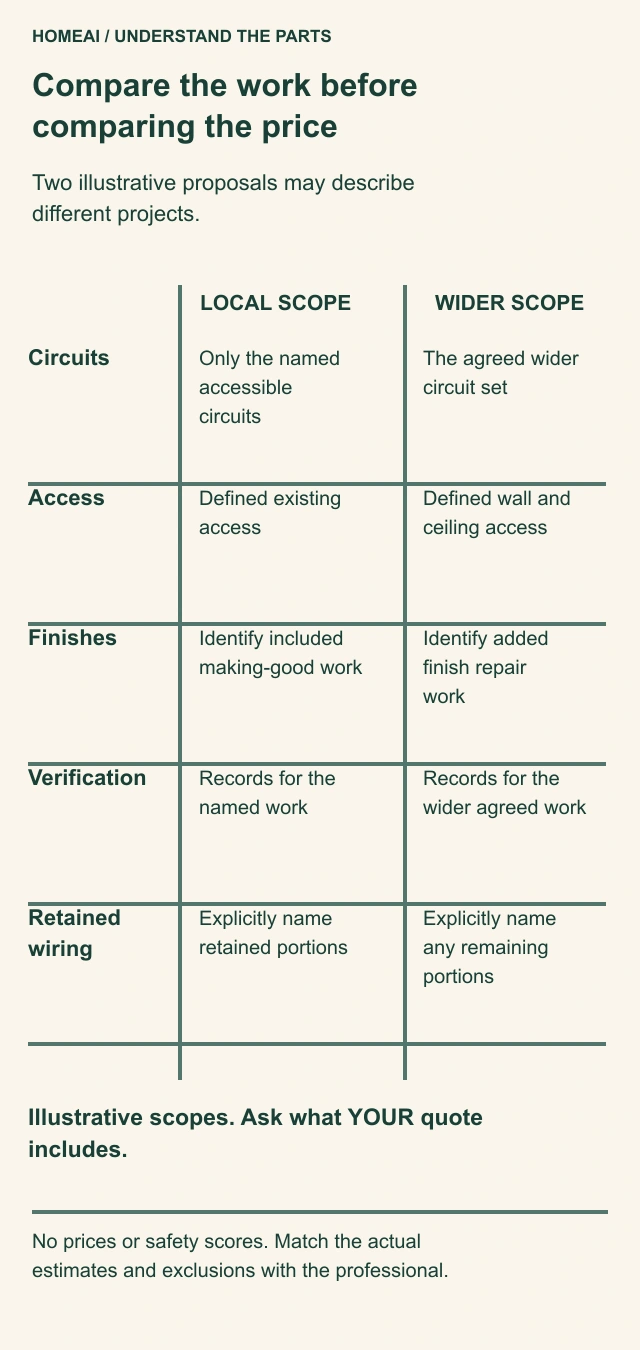
- Circuits
Which circuits are included?
- Access
Which walls or ceilings need access?
- Finishes
Who repairs affected finishes?
- Verification
What work and verification records are included?
- Retained wiring
What wiring remains afterward?
About this illustration
No prices or safety scores. Match the actual estimates and exclusions with the professional.
Compare the work before comparing the price
Two illustrative proposals may describe different projects.
- Circuits
- Which circuits are included?
- Access
- Which walls or ceilings need access?
- Finishes
- Who repairs affected finishes?
- Verification
- What work and verification records are included?
- Retained wiring
- What wiring remains afterward?
Read all the diagram text
- HOMEAI / UNDERSTAND THE PARTS
- Compare the work before
- comparing the price
- Two illustrative proposals may describe
- different projects.
- LOCAL SCOPE
- WIDER SCOPE
- Circuits
- Only the named
- accessible
- circuits
- The agreed wider
- circuit set
- Access
- Defined existing
- access
- Defined wall and
- ceiling access
- Finishes
- Identify included
- making-good work
- Identify added
- finish repair
- work
- Verification
- Records for the
- named work
- Records for the
- wider agreed work
- Retained
- wiring
- Explicitly name
- retained portions
- Explicitly name
- any remaining
- portions
- Illustrative scopes. Ask what YOUR quote
- includes.
- No prices or safety scores. Match the actual
- estimates and exclusions with the professional.
What does “updated electrical” actually tell me?
Consider a simple example: a listing says “updated electrical”, and the documents include a panel-replacement invoice plus basement photographs of newer cable. Those are useful records. They do not automatically say that every circuit to the upper rooms was replaced.
Instead of assuming the claim is either complete or dishonest, ask what each record covers. Which equipment was changed? Which circuits were included? What remains concealed? The electrical professional can help interpret the technical scope and decide what further investigation is useful.
Now add a planned attic-insulation upgrade. The panel invoice cannot settle the wiring in that insulation area. The planned work therefore belongs in the assessment request, and the insurer should receive the report that actually describes the house rather than a simplified “all updated” summary.
This is an illustrative document comparison, not an invented buyer’s completed inspection or a quotation for a real project. Its point is straightforward: a broad phrase becomes useful when it is connected with identifiable work. Where that connection cannot be made, keep the question open until the appropriate investigation or purchase decision resolves it.
What records should come with the completed work?
Keep the original electrical assessment, agreed scope, applicable authority records, invoices and contractor completion information together. Ask what was replaced and what remains. The next owner or contractor should be able to distinguish the original concern from the work that followed it.
Tie the explanation to the property and locations where practical. A description of the circuits or areas covered is more useful than an unlabelled photograph or a product receipt alone. Do not ask a contractor to certify concealed work beyond what its assessment or work can establish.
If a staged plan leaves older wiring, say so plainly in the completion information. Do not let “stage one completed” become “house rewired” as the story is retold. Retain the earlier report so later professionals can see which questions were resolved and which were never investigated.
Give the insurer the agreed completion information and retain its response. Before another renovation affects wiring or insulation, give the new contractor the relevant history. Good records help competent people coordinate work; they are not a permanent guarantee against later damage or alterations.
How do I decide whether this house and the work fit?
Be able to explain what old wiring was identified, what condition concerns were found, what is still concealed and what work is proposed. Add the insurer’s written conditions and the actual access, cost and timing assumptions. If one answer is still a seller’s estimate or an unresolved question, keep it described that way.
An older home’s character can be worth a carefully planned project. The same project may be impractical for another household’s budget, timing or ability to live through disruption. Compare the real undertaking with your needs rather than adopting a blanket opinion about century homes.
A relevant picture helps you recognize a knob, tube, damaged covering or insulation contact. It cannot assess the electrical status of the house you are viewing. A newer panel, a three-slot receptacle and an insurer quotation also answer narrower questions than a complete electrical assessment.
The useful result is clarity: either a home with a workable, understood electrical plan, or a specific reason the remaining work and uncertainty do not fit. You do not need a dramatic universal verdict about knob-and-tube to make a well-supported buying decision.
Keep learning about the connected parts
- Can this home support your electrical plans?
- Aluminum wiring: ask for assessment evidence, not a visual verdict
- Electrical renovation records: what was actually checked?
Canadian context and authorities · Visual atlas · Learning labs
Know the parts.
Know what the words mean.
- Knob
- A ceramic support holding a covered conductor away from a structural surface.
- Tube
- A ceramic sleeve protecting a conductor where it passes through a timber member.
- Conductor insulation
- The wire’s own protective covering, separate from ceramic supports.
- Branch circuit
- The circuit wiring serving particular connected loads beyond the distribution equipment.
- Bonding
- The protective electrical connection that must be identified and assessed by the qualified professional.
- Ground-fault protection
- In the GFCI discussed here, detection of current leakage followed by interruption of supply to reduce shock exposure; it does not create an equipment-bonding connection.
- Retained extent
- The identified old wiring remaining, with its assessment limits.
- Conductor
- The electrically conductive part carrying current; its insulating covering is a different material.
- GFCI
- A ground-fault circuit interrupter: an additional protective device that detects a loss of current and interrupts the supply.
- Retained wiring
- Old wiring left in place after a defined project; its extent and status need an accurate account.
- Reinstatement
- Repairing finishes and affected areas after access for the work.
Questions to bring
to the conversation.
- What old wiring still serves the house, and which concealed portions remain unresolved?
- What conditions or alterations did the qualified electrical professional find?
- What does the insurer require for this property and proposed work sequence?
- Which circuits, access openings, finish repairs and completion records are included in each proposal?
Separate a showing observation, an existing record and a new professional assessment. Unknown means a question remains; it does not automatically mean a defect.
Use the evidence planner ↗Go to the source.
Original HomeAI explanation informed by these public references. Sources support the underlying guidance; they have not reviewed or endorsed HomeAI. Diagrams are conceptual, and calculator outputs depend on your inputs.
Ontario authority sources and the retained historical notice explain this wiring method and its assessment questions. They do not establish current rules in every province, the condition of a particular circuit or an insurer’s acceptance.
Publication & source review
First published .
Sources reviewed .
- Electrical Safety Authority — Knob-and-tube wiring
- ESA — Flash Notice19-16-FL Knob-and-tube wiring
- ESA — Grounded in Ontario Episode14 Knob-and-tube wiring
- Natural Resources Canada — Keeping the Heat In Section3 Materials
- Technical Safety BC · Information Bulletin IB-EL 2023-04, Understanding Single Point Grounding, Revision 02
- CCOHS · Electrical Safety — Basic Information
Have a question about your home?
Start with the symptom, timing and what you have observed.
Ask HomeAI