Jump to a question in this guide
- Define the absence and the property’s actual status
- Make a written plan with named responsibilities
- Ask the actual insurer before relying on a routine
- Choose a water arrangement for the actual building
- Connect heat to pipe exposure and cold conditions
- Keep power and essential-system dependencies explicit
- Understand what monitoring observes and what it cannot do
- Give the attending person a defined, realistic role
- Match alerts and concerns to a response path
- Include the exterior and ongoing property duties
- Review changes to dates, occupancy and arrangements
- Prepare the return before restoring ordinary use
- A fictional owner separates monitoring from attendance
- Retain evidence without overstating what it proves
- Describe the real absence and occupancy facts to the actual insurer rather than borrowing a universal vacancy label.
- Water preparation, local pipe exposure and working heat need a building-specific plan.
- Detection, message receipt, accepted human attendance and response are separate links.
- An absence record should show real visits, changes and service work before the return plan is decided.
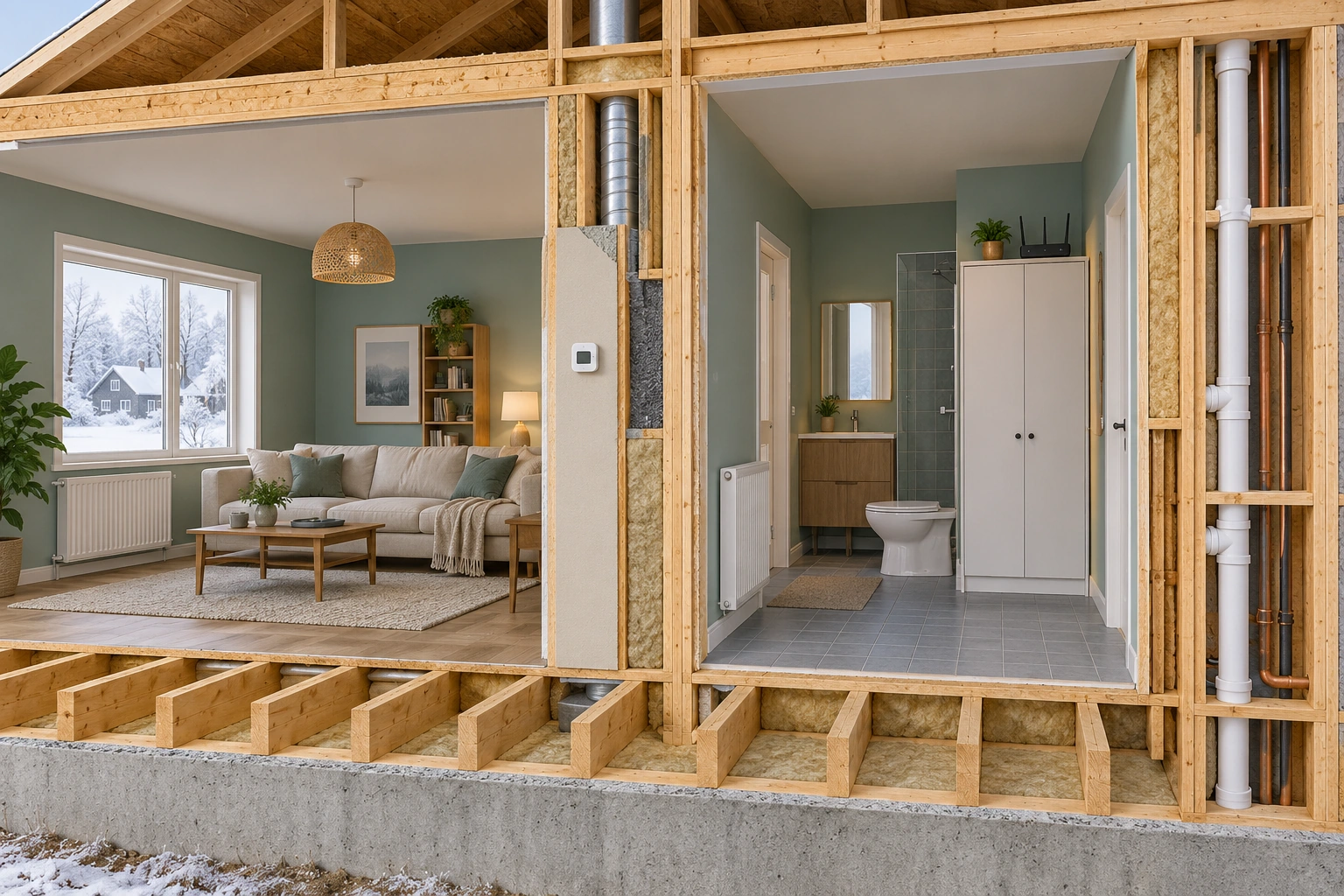
A winter-context house cutaway shows radiators, an external thermostat, a router and visible pipe context beside a closed cupboard.
About this illustration
No temperature, heat operation, freeze protection, valve state, policy compliance or installation approval. This is a conceptual teaching model, not an assessment of your home.
7 picture lessons appear beside the questions in this guide. Use them to understand the explanation, then consider what it means for your home.
Define the absence and the property’s actual status
Leaving a home vacant is a change in how the property is used, watched and maintained. Ordinary household routines may stop while water, heat, electrical services and outside conditions continue. The useful starting point is the actual absence: who is leaving, what remains in the home, which services remain active and who will attend to it. An empty-looking room does not answer those questions.
Insurers may distinguish a temporarily unoccupied home from a vacant one using the actual policy and circumstances. TD Insurance’s current article explains that distinction in its own advisory context. This guide does not adopt its descriptions as universal definitions or decide the status of your property. Describe the circumstances accurately to the actual insurer or adviser and retain their written response.
A holiday, an estate transition, renovation, sale or move can create different responsibilities. The planned return date may also be uncertain. Record the current facts and identify which changes require the adviser or responsible people to be told. A label such as “just away for a while” is not a substitute for the actual duration, occupancy and use information on which advice depends.
This guide owns the connected absence plan: water, heat, monitoring, attendance, response and return. The insurance guide owns wider policy understanding, while plumbing, freezing, power and leak-sensor guides own their technical systems. Connecting those scopes helps prevent an omission; it does not make this article a shutdown manual, coverage opinion or inspection certificate.
The source dates matter. TD’s vacation-security article was modified January 30, 2026; its vacancy article is undated. Calgary’s frozen-water-lines page is current municipal guidance without a substantive publication date. Their numerical temperatures and attendance intervals are not adopted as universal requirements. The actual policy, building systems and current local advice must remain visible in the household plan.
Heat, controls and water remain different systems
A winter-context house cutaway shows radiators, an external thermostat, a router and visible pipe context beside a closed cupboard.
Numbers identify the parts explained below.
- Heat/control
Setting and functioning are distinct.
- Router
Communication has dependencies.
- Pipes
Exposure and system scope need actual assessment.
What does this illustration leave out?
No temperature, heat operation, freeze protection, valve state, policy compliance or installation approval. This illustration explains an idea. It is not an installation guide.
Which actual system states and response responsibilities are agreed?
Explore this with HomeAI ↗Opens an editable question. Nothing is sent until you choose to send it.Separate facts in one absence plan
- Property statusActual circumstances and policy/adviser response.
- PreparationActual provider scope and intended system state.
- MonitoringSpecified sensing/reporting and dependencies.
- Attendance/responseAccepted human role, access and appropriate next decision.
No universal definition, temperature, visit interval or coverage finding.
Further reading: TD Insurance · Vacant home insurance; TD Insurance · Home security tips while on vacation; City of Calgary · Frozen water lines.
Make a written plan with named responsibilities
An absence plan connects conditions to people who can act. It should state what the household has arranged, who attends, how concerns are reported and who authorizes or performs the relevant response. A list of devices alone cannot do that. Start with the property status, dates and essential systems, then assign a real person to each responsibility that continues during the absence.
Distinguish owner decisions, professional technical work and ordinary attendance. A plumber may define a water arrangement, an insurer may state policy conditions and a trusted person may visit. Those are different scopes. Do not ask an attending person to infer a shutdown procedure or interpret policy wording from a device alert. Give them the information and contacts appropriate to the role they have actually accepted.
Acceptance is part of the plan. A name written on a sheet does not establish that the person knows the task, can enter or is available during the relevant period. Confirm the practical arrangement with them through the household’s authorized communication. This guide supplies the planning questions; it does not contact someone, appoint an agent or create a legal responsibility for another person.
Identify what happens if the primary person is unavailable. The backup needs the same practical context: access arrangements, relevant contacts and limits on what they are expected to do. Avoid a chain in which every person assumes someone else will receive the message. The plan should show who makes the next decision when a concern is reported, including when the owner cannot be reached.
Keep the information current and appropriately shared. People attending need enough to perform the agreed role, while unnecessary personal or access information need not be distributed widely. Record changes to dates, contacts and system arrangements together. A useful plan describes what actually applies now, not a previous trip’s assumptions copied forward without review.
An absence plan connects people and systems
Original native teaching figure: An absence plan connects people and systems. Complete labels distinguish the conceptual functions; no actual property finding.
Numbers identify the parts explained below.
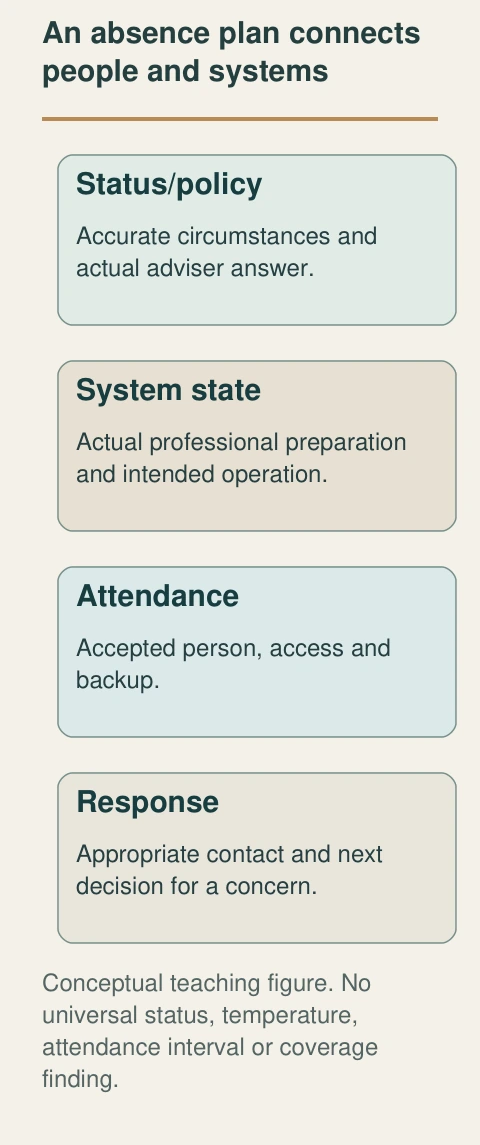
- Status/policy
Accurate circumstances and actual adviser answer.
- System state
Actual professional preparation and intended operation.
- Attendance
Accepted person, access and backup.
- Response
Appropriate contact and next decision for a concern.
What does this illustration leave out?
No universal status, temperature, attendance interval or coverage finding. This illustration explains an idea. It is not an installation guide.
Which dependency has a name but no actual acceptance or evidence?
Explore this with HomeAI ↗Opens an editable question. Nothing is sent until you choose to send it.Read the complete figure
An absence plan connects people and systems
Original native teaching figure: An absence plan connects people and systems. Complete labels distinguish the conceptual functions; no actual property finding.
- Status/policy
- Accurate circumstances and actual adviser answer.
- System state
- Actual professional preparation and intended operation.
- Attendance
- Accepted person, access and backup.
- Response
- Appropriate contact and next decision for a concern.
What remains unknown: No universal status, temperature, attendance interval or coverage finding.
A useful question: Which dependency has a name but no actual acceptance or evidence?
Ask the actual insurer before relying on a routine
Insurance questions should be resolved using the actual policy and accurate circumstances. An online insurer article can explain why status and precautions matter, but it cannot establish another household’s coverage. Ask the actual insurer or adviser which conditions apply to the proposed absence and how they want material changes reported. Keep their response with the relevant policy information.
Describe attendance and monitoring precisely. A connected sensor, a neighbour occasionally looking outside and a person making agreed visits are different arrangements. Do not describe them interchangeably when seeking advice. The insurer needs the actual facts, and the household needs to know which arrangement it has committed to maintain. A technology purchase does not automatically satisfy an attendance condition.
The reviewed TD sources contain specific numerical examples and conditions, including an attendance interval and a suggested temperature. Calgary’s separate page uses another temperature in its local freeze guidance. This guide deliberately adopts neither as a universal rule. The difference illustrates why an absence plan needs the actual policy and technical advice rather than a number selected from a general article.
Ask how to document the arrangement the adviser actually requires. The appropriate record might identify visits, agreed precautions or professional work, but this guide does not prescribe evidence sufficient for a claim. Keep actual records honestly and promptly. A retrospective reconstruction should not be presented as an attendance log made at the time.
If the absence, occupancy, renovation or use changes, return to the adviser with the new circumstances. The earlier answer may have depended on facts that no longer apply. This guide gives no coverage guarantee, discount, rental permission, claim outcome or legal definition. The useful result is a clear current question and the actual adviser’s scoped written response.
Choose a water arrangement for the actual building
Water can remain available to fixtures and equipment while a home is unattended. The household therefore needs a deliberate arrangement for the actual supply and connected systems. Shutting a valve, leaving everything operating and professionally preparing a system for a longer absence are not interchangeable decisions. Ask the appropriate plumber or system provider what the particular building needs.
Identify the services that depend on water before deciding the scope. Fixtures, appliances and other equipment may have separate requirements. A single visible valve does not tell the owner which branches or systems it serves. The appropriate provider should establish the relevant arrangement and explain its limits. This guide gives no valve-operation, draining, winterization or appliance-preparation sequence.
A supply decision also does not answer every drainage or leak question. Water may already be present in equipment or piping, and a receiving drain remains a separate system. A report that the main supply was addressed should identify the actual work performed rather than imply that every possible water source has been removed. Keep the scope and any remaining dependencies explicit.
Coordinate the chosen arrangement with heat, electrical services and monitoring. If an item is expected to remain operating, identify the services and response responsibilities it depends on. The attending person needs to know the intended state without being asked to alter it based on a guess. Technical instructions for an actual system should come from the responsible provider and matching documents.
Retain a record of professional preparation and the intended return process. A photograph of a valve position may show appearance but cannot prove what it controls or whether preparation is complete. Ask who will restore the actual arrangement and what assessment is needed before use. This guide supplies no return-to-service procedure and does not direct an owner to operate an uncertain or damaged system.
One visible valve does not define the whole water plan
A continuous pipe rises from a basement floor, has an external valve and continues toward an upper room.
Numbers identify the parts explained below.

- Pipe
Continuation needs building-specific identity.
- Valve
No operating direction or status claim.
- Upper room
Connected destination remains an actual question.
What does this illustration leave out?
Handle geometry establishes no intended open/closed state, branch scope, permission to operate, draining or winterization result. This illustration explains an idea. It is not an installation guide.
What actual system does this component serve and who defines preparation?
Explore this with HomeAI ↗Opens an editable question. Nothing is sent until you choose to send it.Connect heat to pipe exposure and cold conditions
A heated house can still contain areas where piping has different exposure to cold. Calgary’s frozen-water-lines guidance discusses heat, cold drafts and pipe exposure as relevant concerns. The useful mechanism is local: the temperature and conditions around a particular pipe can differ from the room where a thermostat is located. A displayed room temperature alone cannot establish the condition of every concealed or exposed pipe.
Identify known vulnerable locations and previous concerns from actual records or professional findings. An outside-wall area, a draft or an earlier freeze report is context for an appropriate provider, not an owner diagnosis. Do not ask an attending person to feel along piping, reproduce a draft or run a faucet experiment. The provider should determine the relevant investigation for the actual building.
Heat depends on its own equipment, controls and energy supply. Leaving a setting in place is different from confirming that the system continues to function during the absence. The heating and power guides own those mechanisms. Here, the plan needs to state who notices a loss of expected conditions and who can respond through the appropriate service scope.
No single thermostat number is adopted here. The reviewed municipal and insurer pages have different numerical advice in different contexts, and the actual policy and technical needs may differ again. Ask the relevant professionals and adviser to coordinate the applicable arrangement. Do not treat a general article’s number as a guarantee against freezing or a substitute for a building-specific plan.
Calgary’s page also includes local utility and private-system considerations. Those roles must be confirmed for the actual concern and location rather than assumed nationwide. This guide gives no thawing, flame, heat-cable, insulation, cabinet-opening or water-flow procedure. A suspected freeze or loss of heat needs an appropriate professional response, with the attending person’s safety and agreed role kept clear.
Keep power and essential-system dependencies explicit
An absence plan may rely on powered equipment even when nobody is living in the home. Heating controls, a router, a sensor or other building equipment can have different dependencies. Identify which functions are expected to remain available and ask the relevant provider what they require. The fact that a device has a battery or an indicator light does not establish continuity of the complete function.
A device can depend on more than its own supply. A message may need the home network, an outside communication service and a recipient’s working device. A heating function may depend on several controls and services. Describe the actual chain in the plan, then identify what a failure would mean for attendance and response. This is a coordination question, not an instruction to test or modify electrical equipment.
Ask which services should remain in the agreed state during the absence and who is authorized to change them. A general suggestion to unplug items should not be applied blindly to equipment the plan relies on. The actual manufacturer, qualified provider and insurer advice must be considered together where relevant. This guide supplies no circuit, breaker, power-bar, generator or backup installation procedure.
Keep a known outage distinct from a missing notification. A silent device might reflect ordinary conditions or a communication failure; the lack of a message alone does not prove the house is functioning as intended. Decide with the actual monitoring arrangement how loss of expected contact is handled and who makes the next decision.
The attending person should receive the intended system state and appropriate contacts, not a bundle of unverified operating suggestions. If an alert or visit identifies a concern, the relevant provider should determine the technical assessment and response. Preserve what was already noticed without creating an electrical or heating trial to obtain a clearer result.
Understand what monitoring observes and what it cannot do
Monitoring observes a particular condition or event through the actual device and service. A leak sensor, temperature report or security notification answers a different question. None is a person at the property. TD’s vacancy guidance distinguishes monitoring from actual attendance in its advisory context, which is why the household should describe both accurately to the actual insurer.
Begin with the device’s scope. A sensor near one location cannot independently establish conditions throughout the building. A displayed temperature relates to the actual sensing arrangement, while a leak alert relates to what that device detects. The relevant product instructions and provider should explain the limits. This guide does not establish coverage area, placement, accuracy or performance for an unidentified device.
Notification is another function. An event may be detected without reaching a person who can respond, or a message may reach someone who cannot enter the house. Identify the actual recipient, their availability and the agreed next action. An installed app is not evidence that responsibility has been accepted or that the complete response chain is workable.
Ask how the arrangement handles loss of communication, power or expected reports. The technical monitoring guides own the system mechanisms and matching tests. This absence plan needs the agreed household response to those limits. Do not infer that silence means no concern or that a backup battery guarantees every network and service dependency.
Keep monitoring installation, any scoped verification and real attendance separate in the records. A shared device demonstration is not a site-specific result, and a purchase receipt is not a completed response plan. Describe actual evidence precisely. The useful question is what this arrangement can report, who receives it and what happens next in this particular absence.
Sensing, communication and receiving are different roles
A plain wall sensor, closed router and dark phone appear as separate objects in a living-room cutaway.
Numbers identify the parts explained below.

- Sensor
Actual observation scope.
- Router
Communication dependency.
- Phone
Receipt and response need accepted roles.
What does this illustration leave out?
No actual sensing range, power/network continuity, alert delivery, accepted recipient or attendance equivalence. This illustration explains an idea. It is not an installation guide.
How does the real report reach an available person who can act?
Explore this with HomeAI ↗Opens an editable question. Nothing is sent until you choose to send it.A sensor is one part of a response chain
Original native teaching figure: A sensor is one part of a response chain. Complete labels distinguish the conceptual functions; no actual property finding.
Numbers identify the parts explained below.
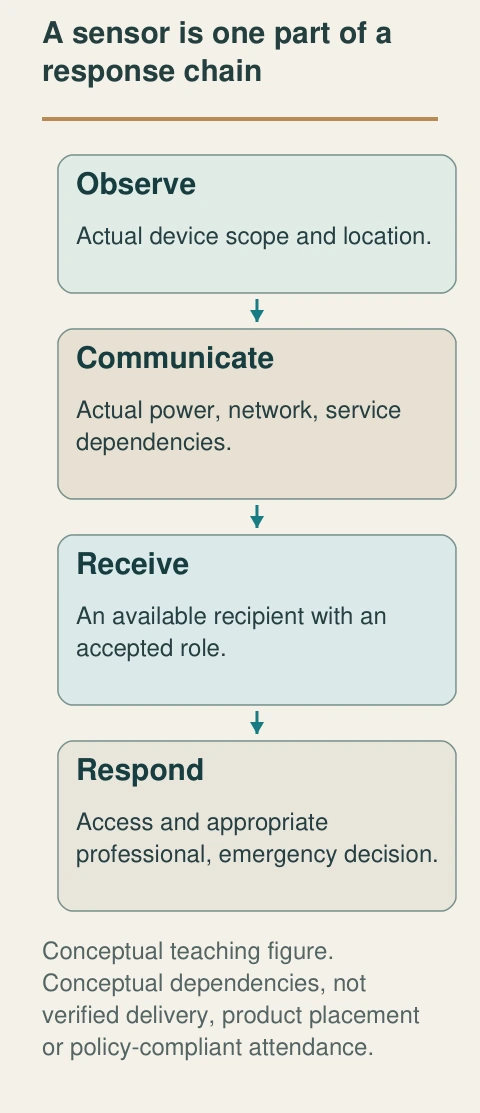
- Observe
Actual device scope and location.
- Communicate
Actual power, network, service dependencies.
- Receive
An available recipient with an accepted role.
- Respond
Access and appropriate professional, emergency decision.
What does this illustration leave out?
Conceptual dependencies, not verified delivery, product placement or policy-compliant attendance. This illustration explains an idea. It is not an installation guide.
What happens if the expected message or recipient is unavailable?
Explore this with HomeAI ↗Opens an editable question. Nothing is sent until you choose to send it.Four different monitoring questions
- ObserveWhat this actual device detects.
- CommunicateWhich power/network/service dependencies carry the report.
- ReceiveWho actually receives and accepts the role.
- RespondWho can attend or obtain appropriate help.
No product placement/performance, verified notification or substitution for actual policy attendance.
Further reading: TD Insurance · Vacant home insurance; TD Insurance · Home security tips while on vacation.
Read the complete figure
A sensor is one part of a response chain
Original native teaching figure: A sensor is one part of a response chain. Complete labels distinguish the conceptual functions; no actual property finding.
- Observe
- Actual device scope and location.
- Communicate
- Actual power, network, service dependencies.
- Receive
- An available recipient with an accepted role.
- Respond
- Access and appropriate professional, emergency decision.
What remains unknown: Conceptual dependencies, not verified delivery, product placement or policy-compliant attendance.
A useful question: What happens if the expected message or recipient is unavailable?
Give the attending person a defined, realistic role
Attendance should mean a specific agreed role rather than a vague request to keep an eye on the house. The actual policy and professional advice may influence the arrangement, but the attending person also needs practical clarity. State when they are expected, what ordinary observations they are to report and whom they contact. Do not ask them to diagnose a building system merely because they can enter.
Access is a separate dependency. The person needs an agreed means of entering and a way to handle an access problem. Consider the actual doors, locks and any building-management arrangements before departure. This guide gives no lock-bypass method or instruction to share credentials broadly. Keep access information limited to the people who need it for the accepted role.
Provide the intended state of the house in plain language. For example, they need to know which systems have been professionally prepared and which are expected to remain operating. That description should come from the actual plan and records. A person cannot reliably report a changed condition if nobody told them what the agreed arrangement was.
Set boundaries around the response. An unusual smell, visible water, loss of heat or damaged entry may require an appropriate professional or emergency service rather than further observation. The attending person should not enter a hazardous situation, operate uncertain equipment or reproduce a leak. Agree how they report a concern and who can authorize the relevant next step.
Record actual attendance honestly, using the arrangement the insurer or responsible adviser requires where applicable. Note the date and already observed concern without claiming a technical inspection occurred. If a visit is missed or the person becomes unavailable, use the agreed backup and update the plan. A planned visit and a completed visit are different facts.
Match alerts and concerns to a response path
A response path begins with a report and ends with a responsible decision or action. It can fail even where the device or attending person works as expected. A message sent to an unavailable owner, a provider without access or a helper without authority can leave the concern unresolved. Connect those practical dependencies before the absence begins.
Identify the appropriate contact for each scope. Water, heating, electrical, security and insurance questions may require different people. Keep emergency situations distinct from routine service inquiries. This guide gives no universal dispatch threshold or treatment procedure; the actual circumstances and relevant emergency or professional advice determine the response.
State what the attending person may do within their accepted role and what requires the owner or another authorized decision-maker. Do not use a general absence note to assign legal authority or unlimited spending. If the household needs a formal arrangement, obtain the appropriate advice and documents. The practical plan should accurately reflect whatever authority has actually been established.
Ask the relevant providers how they can be reached and what access or information they need. A telephone number copied from an old invoice does not establish current availability. The plan can identify a preferred provider without guaranteeing attendance or priority. Where availability is uncertain, record that limit and the agreed alternative rather than promising a response time.
When a concern occurs, preserve the report and subsequent decisions. Distinguish the alert, attendance, professional finding and completed work. Those records help explain what happened without turning a device notification into a diagnosis or an owner instruction into a verified repair. Insurance communication and any claim remain separate processes governed by the actual policy and advice.
Include the exterior and ongoing property duties
The exterior continues to experience weather and ordinary change during an absence. The household needs to identify the actual responsibilities that continue, including any building-management or service arrangements. A plan focused only on indoor sensors may omit those duties. Describe who attends to them and how a reported exterior concern reaches the appropriate provider.
Local and shared-property requirements need their own confirmation. A detached house, condominium and managed property can have different arrangements. This guide does not assign legal maintenance duties or declare which party owns a particular service. Ask the actual manager, adviser or local authority where a responsibility is unclear, and retain the answer with the relevant scope.
Security is part of the plan but should not be confused with building condition. An entry notification does not report roof drainage, and an exterior glance does not establish that every system is sound. Describe the attending person’s ordinary observation role precisely. The roof, drainage and security guides own their technical questions and matching assessment methods.
Avoid tasks that require an unqualified person to climb, open equipment or approach a hazardous condition. A report made from an ordinary safe location can identify the need for a relevant provider. The provider determines the appropriate technical investigation. An absence should not turn a helpful neighbour into a roof, electrical or structural inspector.
If weather or a reported event changes the plan, coordinate the response with the actual insurer and responsible providers as appropriate. Record what was observed and what action was taken. Do not claim that an exterior attendance arrangement eliminates weather damage or establishes coverage. Its purpose is to give ongoing responsibilities and concerns a workable path to action.
Review changes to dates, occupancy and arrangements
An absence plan can become inaccurate without any equipment failure. The return date may move, a helper may become unavailable or someone may begin using part of the property. Those changes can affect both practical responsibilities and the facts previously given to an insurer. Review the current circumstances rather than assuming the original plan remains valid.
Name the person responsible for keeping the plan current. When a date or service arrangement changes, update the affected contacts and records together. A backup person should not be working from an old version while the owner assumes they have new instructions. Keep the current arrangement easy to identify and retain earlier versions as history where useful.
Changed occupancy or use deserves specific advice. A relative staying briefly, a renovation beginning or a proposed rental is not automatically covered by an earlier answer about a different absence. Describe the actual new circumstances to the relevant insurer or adviser. This guide supplies no rental permission, legal status, policy interpretation or coverage outcome.
If a professional alters a system during the absence, obtain the actual scope and intended state after the work. The attending person and monitoring arrangement may need that information. A service visit can change what the next observer should expect. Avoid interpreting a completed invoice as proof that every connected system was assessed.
Keep unresolved questions visible when plans change quickly. A note stating that attendance or a technical arrangement still needs confirmation is more useful than silently copying an obsolete assumption. The next step should identify the responsible person and appropriate inquiry. Do not manufacture a record of acceptance, attendance or professional verification that has not occurred.
Prepare the return before restoring ordinary use
Returning is another change in the home’s operating arrangement. Systems may have been professionally prepared, equipment may have been left in a particular state and concerns may have been reported while the owner was away. Review those records before assuming that ordinary use can resume. The appropriate provider should define any return-to-service work for the actual systems.
Ask who restores the intended water, heating or equipment arrangement and what evidence is required within that scope. This guide gives no valve-opening, flushing, draining, heating restart or appliance sequence. A generic return checklist cannot account for an unidentified system, professional preparation or damage that occurred during the absence.
Connect the attendance record, monitoring reports and any service work. A concern may have been investigated, remain unresolved or have changed the system’s intended state. Distinguish those outcomes. A cleared notification is not necessarily a professional finding, and a completed repair may have a limited scope. Obtain the actual provider’s explanation where the record is unclear.
If there is visible damage, an unusual condition or reason to suspect a hazard, obtain the appropriate professional or emergency advice before entering or operating affected equipment. Do not reproduce the condition to see whether it persists. Preserve already known information when safe, but urgent response and personal safety take precedence over photographs or a detailed log.
After the relevant return work and advice, update the property and insurance arrangements to the actual circumstances. Keep the absence history as a record of what happened, not proof that no damage occurred. The useful handover states the systems and concerns addressed, the actual findings and any remaining limits. It does not declare the whole building sound from one visit.
Return includes records and the actual system state
A closed document folder rests on an entry bench, with unused gloves and intact equipment enclosures through a utility doorway.
Numbers identify the parts explained below.

- Folder
Actual records need review.
- Equipment
Appearance is not operating verification.
- Doorway
Access is separate from technical restoration.
What does this illustration leave out?
No permission to enter a hazardous room, restart equipment, operate valves or declare a safe return. This illustration explains an idea. It is not an installation guide.
Who defines the actual return-to-service work and remaining limits?
Explore this with HomeAI ↗Opens an editable question. Nothing is sent until you choose to send it.Return starts with the actual records
Original native teaching figure: Return starts with the actual records. Complete labels distinguish the conceptual functions; no actual property finding.
Numbers identify the parts explained below.
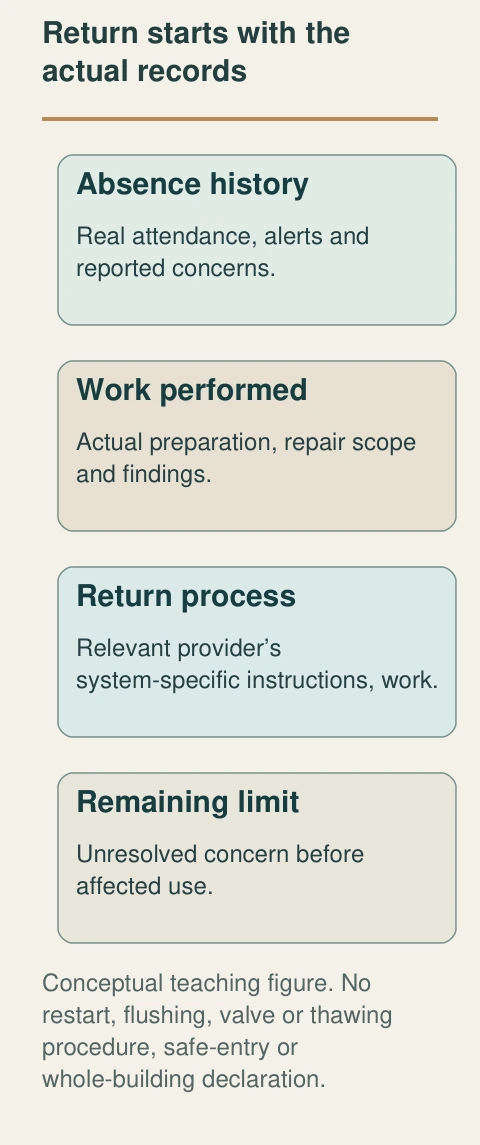
- Absence history
Real attendance, alerts and reported concerns.
- Work performed
Actual preparation, repair scope and findings.
- Return process
Relevant provider’s system-specific instructions, work.
- Remaining limit
Unresolved concern before affected use.
What does this illustration leave out?
No restart, flushing, valve or thawing procedure, safe-entry or whole-building declaration. This illustration explains an idea. It is not an installation guide.
Who establishes the actual system state before ordinary use resumes?
Explore this with HomeAI ↗Opens an editable question. Nothing is sent until you choose to send it.Return evidence keeps its scope
- Attendance historyWhat was actually reported during the absence.
- Professional workActual preparation/repair scope and findings.
- RestorationThe relevant provider’s defined return-to-service process.
- Unresolved concernAppropriate assessment before affected use.
No owner restart/flush/valve procedure or whole-property soundness declaration.
Further reading: TD Insurance · Vacant home insurance; TD Insurance · Home security tips while on vacation; City of Calgary · Frozen water lines.
Read the complete figure
Return starts with the actual records
Original native teaching figure: Return starts with the actual records. Complete labels distinguish the conceptual functions; no actual property finding.
- Absence history
- Real attendance, alerts and reported concerns.
- Work performed
- Actual preparation, repair scope and findings.
- Return process
- Relevant provider’s system-specific instructions, work.
- Remaining limit
- Unresolved concern before affected use.
What remains unknown: No restart, flushing, valve or thawing procedure, safe-entry or whole-building declaration.
A useful question: Who establishes the actual system state before ordinary use resumes?
A fictional owner separates monitoring from attendance
Nora is a fictional owner planning an uncertain absence. She has a temperature-reporting device and a friend, Daniel, who agrees in this example to make visits and report ordinary observations. He is not agreeing to diagnose heating or operate unfamiliar equipment. Nora separately asks her insurer and system providers what the proposed absence requires.
They compare two example records: a visit entry describes attendance and what Daniel noticed; a device message has no confirmed receipt. The visit does not prove alert delivery, and the unconfirmed message does not diagnose damage. Nora realizes that a notification still needs an available person who can enter and arrange the appropriate response.
Daniel will be unavailable for part of the absence, and the proposed second contact has not accepted. Nora changes the departure arrangement until that gap is resolved rather than calling the device a substitute for attendance. She gives the accepted helper the intended system state, contact route and limits of the role.
If her return date changes, she revisits the insurer advice and accepted visits. Before ordinary use resumes, the relevant provider reviews the actual preparation and intervening concerns to define any restoration work. The fictional decision is to resolve a missing responsibility before relying on the plan; it supplies no coverage, technical inspection, verified alert or safe-return finding.
Retain evidence without overstating what it proves
An absence file should bring together the current plan, actual adviser responses, professional preparation, attendance and reported concerns. These records answer different questions. The plan states intentions, a visit log states attendance and a provider report states findings within its scope. Keep those differences clear so a later reader can understand what actually occurred.
Use actual dates and identities. A scheduled visit is not a completed visit; a requested service is not a professional assessment. If a record was made later, describe it honestly rather than implying it was written at the time. Do not fill gaps with assumed observations or convert a device’s silence into evidence that conditions remained normal.
Keep technical records tied to the actual system and work. A water-preparation invoice, heating service record or monitoring document should identify its scope and limits. Ask the provider about unclear wording. An owner should not broaden “work completed” into a whole-property condition statement, and a photograph cannot verify every concealed component or future operating result.
Insurance records retain their own purpose. The actual policy and adviser determine requirements and the handling of a potential claim. This guide does not prescribe evidence that guarantees acceptance or interpret an exclusion. Preserve relevant information and communicate accurately through the appropriate process without claiming a coverage result that has not been established.
Use the return review to improve the next plan. An unavailable contact, unclear instruction or changed dependency is a practical lesson even when no damage is known. Update the actual arrangement and retain useful history. The aim is an absence plan people can understand and act on, with professional and policy questions resolved in their proper scopes rather than hidden behind a general statement that the home was monitored.
Keep learning about the connected parts
- Prepare exposed plumbing for a cold spell
- A power outage plan for heating, water and communications
- Leak sensors and automatic shutoff: understand detection, valve action and response
- Build a home-care record that the next person can understand
Canadian context and authorities · Visual atlas · Learning labs
Practice the distinction.
A missing backup changes the departure plan
Nora is a fictional owner planning an uncertain absence. She has a temperature-reporting device and a friend, Daniel, who agrees in this example to make visits and report ordinary observations. He is not agreeing to diagnose heating or operate unfamiliar equipment. Nora separately asks her insurer and system providers what the proposed absence requires.
Reported observations
- They compare two example records: a visit entry describes attendance and what Daniel noticed; a device message has no confirmed receipt. The visit does not prove alert delivery, and the unconfirmed message does not diagnose damage. Nora realizes that a notification still needs an available person who can enter and arrange the appropriate response.
- Daniel will be unavailable for part of the absence, and the proposed second contact has not accepted. Nora changes the departure arrangement until that gap is resolved rather than calling the device a substitute for attendance. She gives the accepted helper the intended system state, contact route and limits of the role.
A useful next question
If her return date changes, she revisits the insurer advice and accepted visits. Before ordinary use resumes, the relevant provider reviews the actual preparation and intervening concerns to define any restoration work. The fictional decision is to resolve a missing responsibility before relying on the plan; it supplies no coverage, technical inspection, verified alert or safe-return finding.
Clearly fictional teaching record; no actual property, safety, legal or insurance approval.
Know what the words mean.
- Property status
- Actual occupancy and use circumstances described to the relevant insurer/adviser.
- System preparation
- The actual provider’s defined work and intended state for a particular building system.
- Monitoring
- Observation/reporting through the actual device and service, with its own dependencies.
- Attendance
- An accepted human visit role, distinct from monitoring or a technical inspection.
- Response path
- The contacts, access and decisions that connect a concern to appropriate action.
Questions to bring
to the conversation.
- Which absence, occupancy and changed-date facts does the actual insurer’s advice address?
- Which systems remain operating and which were professionally prepared, with what return instructions?
- Who accepted visits and backup cover, and can they enter through the agreed arrangement?
- What happens if the sensor reports nothing, a message is unconfirmed or a recipient cannot attend?
- Which alerts, attendance records and unresolved conditions must the return provider review?
Separate a showing observation, an existing record and a new professional assessment. Unknown means a question remains; it does not automatically mean a defect.
Use the evidence planner ↗Go to the source.
Original HomeAI explanation informed by these public references. Sources support the underlying guidance; they have not reviewed or endorsed HomeAI. Diagrams are conceptual, and calculator outputs depend on your inputs.
All three current substantive primary bodies personally read. Actual insurer/policy and Calgary-local limits explicit; differing numerical temperature advice deliberately not generalized. No shutdown/thaw/return recipe, legal status, coverage/claim result or monitoring guarantee. FictionalNora only; related destinations checked against current canonical intent owners.
Publication & source review
First published .
Sources reviewed .
Have a question about your home?
Start with the symptom, timing and what you have observed.
Ask HomeAI