- Heat removal, compartment air distribution and control selection are different functions. A selected level or powered light is not a measured cooling result.
- The named Danby manual documents automatic defrost and a water route to a tray near the compressor. It does not identify the source of water noticed outside an appliance.
- Match the model and manual, retain existing temperature history and ordinary context, and ask for a scoped appliance assessment. Food decisions and property clearance remain separate.
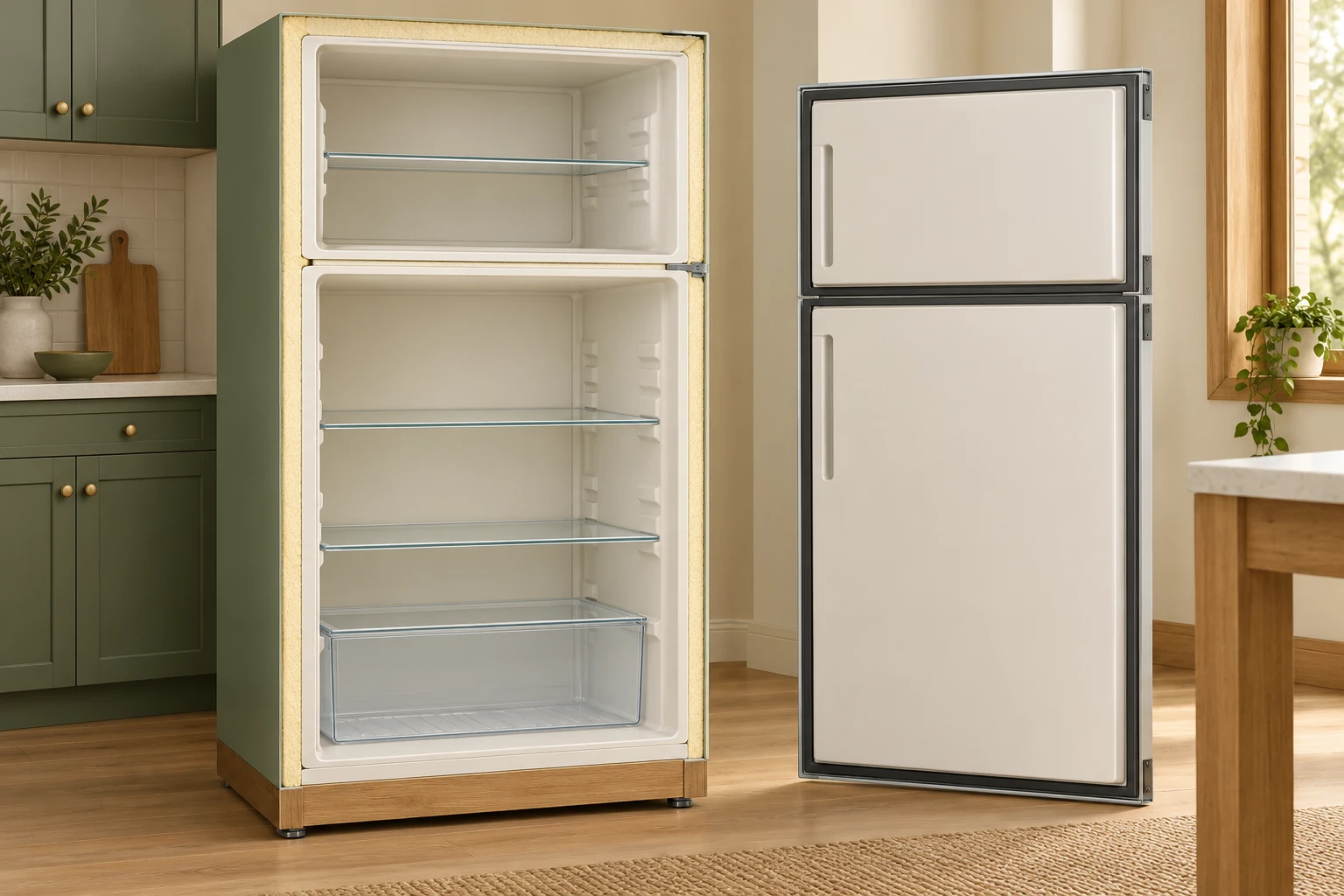
The generic cabinet model shows two empty compartments, glass-like shelves and a clear lower drawer-like box. A pale textured band is visible at the cutaway edge. A separate two-panel door specimen has a dark border. Plain interior walls conceal the equipment; no control reading or airflow arrow appears.
About this illustration
This illustration is a generic architectural slice, not the named Danby model or an instruction to remove a door. The exposed edge establishes no actual insulation material, thickness or thermal result. Hidden fan, duct, coil, sensor and refrigerant routing, door sealing, compartment temperatures and the condition of stored contents remain unknown. This is a conceptual teaching model, not an assessment of your home.
10 picture lessons appear beside the questions in this guide. Use them to understand the explanation, then consider what it means for your home.
Cooling is the removal of heat
A refrigerator cools its storage space by removing heat and delivering heat elsewhere, using electricity to drive the process. Natural Resources Canada explains that refrigerators use the same heat-transfer principles as heat pumps. Heat naturally tends to flow from warmer to colder surroundings. Moving heat from a colder storage space into warmer surroundings requires electrical work; the control level does not supply that work. A cooling control influences the appliance's operation; it does not supply a substance called cold. Understanding heat removal helps separate the requested condition from the work needed to achieve it.
In NRCan's functional explanation, refrigerant absorbs, transports and releases heat. Compression raises the refrigerant's pressure and temperature; a condenser releases heat to its surroundings, and an expansion device lowers pressure before heat absorption can occur again. These are different roles in a process. They are not a map of the tubing, coils or valves inside your cabinet. The existing heat-pump physics guide develops the general cycle; this lesson applies the distinction to refrigerated compartments.
The concrete appliance example is Danby's DFF101B1WDB and the other models named in its combined manual. Danby Canada currently links the manual whose cover reads 2022.07.19. That current link establishes the documentation match, not a 2026 redesign. Its named functions explain the following lessons; another refrigerator or freezer needs its own applicable manual.
Heat removal, compartment air and the door boundary
The generic cabinet model shows two empty compartments, glass-like shelves and a clear lower drawer-like box. A pale textured band is visible at the cutaway edge. A separate two-panel door specimen has a dark border. Plain interior walls conceal the equipment; no control reading or airflow arrow appears.
Numbers identify the parts explained below.
- Heat removal
Cooling removes thermal energy from the storage space. The picture locates a cabinet space without showing the working refrigerant circuit or proving cooling performance.
- Compartment air
Cold air must circulate around contents, according to Health Canada. Empty shelves in a model do not map a real air route, identify a fan or establish uniform temperature.
- Door boundary
The named manual includes a magnetic gasket and door-use influences. This separate door specimen provides no seal test, control procedure or finding about an installed door.
What does this illustration leave out?
This illustration is a generic architectural slice, not the named Danby model or an instruction to remove a door. The exposed edge establishes no actual insulation material, thickness or thermal result. Hidden fan, duct, coil, sensor and refrigerant routing, door sealing, compartment temperatures and the condition of stored contents remain unknown. This illustration explains an idea. It is not an installation guide.
Does the available record describe a selected control level, a particular temperature observation or an assessed physical function?
Explore this with HomeAI ↗Opens an editable question. Nothing is sent until you choose to send it.The heat-transfer roles are different functions
Read the different jobs beside the evidence needed to understand the actual home.
- Heat absorptionIn NRCan's abstract cooling explanation, refrigerant takes up heat from its surroundings; removing heat cools the source space.
- CompressionThe compressor raises refrigerant temperature as part of transferring heat between source and sink.
- Heat releaseThe condenser gives heat to its surroundings as refrigerant becomes liquid.
- ExpansionThe expansion device lowers pressure and temperature before further heat absorption.
Abstract refrigeration functions only. The HVAC source does not establish the Danby cabinet's piping, locations, refrigerant identity or reversing arrangement, and supplies no service procedure.
Natural Resources Canada · Heating and cooling with a heat pump (Visible and HTML metadata Date modified: December 24, 2025. HTTP Last-Modified October 2, 2026 is separate transport metadata.). Source bodies reviewed October 4, 2026. Their own dates, models and geographic limits remain in the complete reference panel. Conceptual education supplies no property-specific approval.
Compartments also need an air-distribution role
Moving heat through a refrigerant process and moving cold air around stored contents are different jobs. Health Canada's fridge guidance says cold air must circulate and advises against packing the refrigerator. A working heat-removal process cannot, by its name alone, establish the temperature throughout a compartment. Air distribution and the arrangement of stored items remain relevant to that result.
The Danby features page identifies refrigerator and freezer compartments, shelves and separate compartment controls. Those visible divisions help name the space being discussed. They do not reveal the hidden fan, duct or coil arrangement, or prove whether the two compartments share a particular air route. A control in each compartment is not evidence of two independent refrigeration systems.
Keep the observation specific: refrigerator compartment, freezer compartment or a stated existing thermometer record. A result from one place cannot silently become a result everywhere else. Ask the provider to explain the actual model's distribution arrangement when it matters to a changed condition. There is no need to remove a liner or open an equipment panel to prepare that question.
Heat removal, compartment air and the door boundary
The generic cabinet model shows two empty compartments, glass-like shelves and a clear lower drawer-like box. A pale textured band is visible at the cutaway edge. A separate two-panel door specimen has a dark border. Plain interior walls conceal the equipment; no control reading or airflow arrow appears.
Numbers identify the parts explained below.
- Heat removal
Cooling removes thermal energy from the storage space. The picture locates a cabinet space without showing the working refrigerant circuit or proving cooling performance.
- Compartment air
Cold air must circulate around contents, according to Health Canada. Empty shelves in a model do not map a real air route, identify a fan or establish uniform temperature.
- Door boundary
The named manual includes a magnetic gasket and door-use influences. This separate door specimen provides no seal test, control procedure or finding about an installed door.
What does this illustration leave out?
This illustration is a generic architectural slice, not the named Danby model or an instruction to remove a door. The exposed edge establishes no actual insulation material, thickness or thermal result. Hidden fan, duct, coil, sensor and refrigerant routing, door sealing, compartment temperatures and the condition of stored contents remain unknown. This illustration explains an idea. It is not an installation guide.
Does the available record describe a selected control level, a particular temperature observation or an assessed physical function?
Explore this with HomeAI ↗Opens an editable question. Nothing is sent until you choose to send it.Read what each named control represents
The example manual describes snowflake levels running from warmer to colder for both refrigerator and freezer selection. These levels identify a selection within the named control scheme. They are not displayed Celsius measurements, and this guide provides no conversion from a snowflake to Health Canada's temperature goals. Copy the meaning from the matching manual before interpreting a saved control photograph.
The same manual describes a compressor-off state in which the power light remains illuminated while cooling does not operate. That is a useful distinction between an indication and a physical function. It does not diagnose a lit light on an unfamiliar appliance or provide a reason to change the controls. The model's documented state must be established first.
A separate crisper humidity gauge uses water-drop symbols for less or more humid conditions. Its role is different again: it describes the crisper's humidity control, rather than a compartment temperature reading or the humidity of the home. Preserve an existing selection as context. Neither a familiar symbol nor several illuminated indicators confirms the stored contents' condition.
Heat removal, compartment air and the door boundary
The generic cabinet model shows two empty compartments, glass-like shelves and a clear lower drawer-like box. A pale textured band is visible at the cutaway edge. A separate two-panel door specimen has a dark border. Plain interior walls conceal the equipment; no control reading or airflow arrow appears.
Numbers identify the parts explained below.
- Heat removal
Cooling removes thermal energy from the storage space. The picture locates a cabinet space without showing the working refrigerant circuit or proving cooling performance.
- Compartment air
Cold air must circulate around contents, according to Health Canada. Empty shelves in a model do not map a real air route, identify a fan or establish uniform temperature.
- Door boundary
The named manual includes a magnetic gasket and door-use influences. This separate door specimen provides no seal test, control procedure or finding about an installed door.
What does this illustration leave out?
This illustration is a generic architectural slice, not the named Danby model or an instruction to remove a door. The exposed edge establishes no actual insulation material, thickness or thermal result. Hidden fan, duct, coil, sensor and refrigerant routing, door sealing, compartment temperatures and the condition of stored contents remain unknown. This illustration explains an idea. It is not an installation guide.
Does the available record describe a selected control level, a particular temperature observation or an assessed physical function?
Explore this with HomeAI ↗Opens an editable question. Nothing is sent until you choose to send it.Selected control information and temperature evidence differ
Read the different jobs beside the evidence needed to understand the actual home.
- Named selected levelDanby's snowflakes identify a warmer-to-colder selection; they are not a Celsius measurement or a conversion to a public-health goal.
- Named power indicationIn its documented compressor-off state, the power light can remain lit while cooling does not operate. This does not diagnose another model's light.
- Compartment airHealth Canada says cold air must circulate; a selection does not establish the actual airflow or temperature throughout stored contents.
- Existing temperature recordA reading belongs to its stated unit, time and compartment/context. It cannot reconstruct every stored item's prior condition.
No control sequence, preferred setting, calibration, thermometer-placement procedure, hidden fan/duct assumption, food clearance or whole-compartment result.
Danby · DFF101B1WDB / DFF101B1BDB / DFF101B1BSLDB / DFF101B2WDB owner manual (Visible cover 2022.07.19; PDF created and modified July 19, 2022. This is the exact manual currently linked by Danby Canada's DFF101B1WDB page, rather than a 2026 technical edition.); Health Canada · Interactive food-safety guide: fridge (Visible Date modified: January 10, 2023. The current official body was captured October 4, 2026.); Health Canada · Safe food storage (Page details: April 11, 2024. HTTP Last-Modified October 3, 2026 is transport metadata, not a new publication date.). Source bodies reviewed October 4, 2026. Their own dates, models and geographic limits remain in the complete reference panel. Conceptual education supplies no property-specific approval.
The door and seal are part of the boundary
The named manual identifies a magnetic gasket at the door. This is the sealing interface between the closed door and cabinet. It also says internal temperature varies with how often the door is opened, and lists improper closure among possible explanations for inadequate cooling or continuous operation. Door use therefore belongs beside the cooling question, rather than being treated as an unrelated detail.
Ordinary context might include a door noticed incompletely closed or a package visibly interfering during normal use. Describe what was actually noticed and when. A photograph of a closed door does not measure the seal, and a manufacturer's tight-seal description does not establish airtightness or temperature performance for the installed appliance.
Keep observations external and incidental to normal use. Do not pull the gasket, force the door, perform a paper test, adjust hinges or remove the door to investigate. A qualified appliance provider can assess a closure or seal question within the actual model's service scope.
Heat removal, compartment air and the door boundary
The generic cabinet model shows two empty compartments, glass-like shelves and a clear lower drawer-like box. A pale textured band is visible at the cutaway edge. A separate two-panel door specimen has a dark border. Plain interior walls conceal the equipment; no control reading or airflow arrow appears.
Numbers identify the parts explained below.
- Heat removal
Cooling removes thermal energy from the storage space. The picture locates a cabinet space without showing the working refrigerant circuit or proving cooling performance.
- Compartment air
Cold air must circulate around contents, according to Health Canada. Empty shelves in a model do not map a real air route, identify a fan or establish uniform temperature.
- Door boundary
The named manual includes a magnetic gasket and door-use influences. This separate door specimen provides no seal test, control procedure or finding about an installed door.
What does this illustration leave out?
This illustration is a generic architectural slice, not the named Danby model or an instruction to remove a door. The exposed edge establishes no actual insulation material, thickness or thermal result. Hidden fan, duct, coil, sensor and refrigerant routing, door sealing, compartment temperatures and the condition of stored contents remain unknown. This illustration explains an idea. It is not an installation guide.
Does the available record describe a selected control level, a particular temperature observation or an assessed physical function?
Explore this with HomeAI ↗Opens an editable question. Nothing is sent until you choose to send it.Room conditions change the heat-transfer context
The surroundings matter because heat removed from storage must be transferred elsewhere. The example manual cautions about nearby heat sources and direct sunlight, and says extreme cold ambient conditions can cause improper performance. Its troubleshooting lists also include high room temperature or humidity. These are source-supported influences, not numerical predictions for your kitchen.
This named unit is intended for temperature-controlled indoor household use and freestanding installation. The manual does not make it a suitable outdoor or uncontrolled-garage appliance merely because it fits the space. Another model may have different requirements. Use the actual documentation and an appropriate provider to resolve an installation question; this lesson supplies no ambient range or clearance dimensions.
Record relevant existing room or location information without moving the appliance to inspect behind it. A change in surroundings can be useful context, but it does not isolate the cause of a changed temperature or a higher bill. The energy-bill guide owns consumption comparisons; appliance runtime and a product label are not a personal savings calculation.
Heat removal, compartment air and the door boundary
The generic cabinet model shows two empty compartments, glass-like shelves and a clear lower drawer-like box. A pale textured band is visible at the cutaway edge. A separate two-panel door specimen has a dark border. Plain interior walls conceal the equipment; no control reading or airflow arrow appears.
Numbers identify the parts explained below.
- Heat removal
Cooling removes thermal energy from the storage space. The picture locates a cabinet space without showing the working refrigerant circuit or proving cooling performance.
- Compartment air
Cold air must circulate around contents, according to Health Canada. Empty shelves in a model do not map a real air route, identify a fan or establish uniform temperature.
- Door boundary
The named manual includes a magnetic gasket and door-use influences. This separate door specimen provides no seal test, control procedure or finding about an installed door.
What does this illustration leave out?
This illustration is a generic architectural slice, not the named Danby model or an instruction to remove a door. The exposed edge establishes no actual insulation material, thickness or thermal result. Hidden fan, duct, coil, sensor and refrigerant routing, door sealing, compartment temperatures and the condition of stored contents remain unknown. This illustration explains an idea. It is not an installation guide.
Does the available record describe a selected control level, a particular temperature observation or an assessed physical function?
Explore this with HomeAI ↗Opens an editable question. Nothing is sent until you choose to send it.Automatic defrost has a separate water job
The matched Danby manual documents an automatic defrost function and says this appliance does not require manual defrosting. It then describes another physical task: defrost water is channelled into a drip tray near the compressor, where heat transfer from the compressor causes evaporation. Cooling, frost removal and handling the resulting water are connected functions with different questions.
Defrost water is liquid water being handled by that documented route. Refrigerant is the working fluid described in the heat-transfer explanation. Naming both fluids prevents a tray observation from becoming a refrigerant finding. The manual does not establish the hidden channel geometry, defrost trigger, heater position or event duration. An outdoor heat pump's reverse-cycle explanation should not be assigned to this cabinet.
Water noticed outside an appliance needs its own location and timing account. The documented tray function does not prove that a particular patch came from it, that a drain failed or that wetness is normal. Ice makers, plumbed water and filters introduce additional model-specific questions where they exist; their arrangements are not established by these sources. Do not access the tray, clear a hidden drain or force a defrost event.
Defrost water and refrigerant have different jobs
A translucent textured sheet and clear droplet forms sit above the left stand. A shallow cream tray with a reflective surface occupies the centre stand. A closed rounded dark green casing occupies the right stand. The three specimens have no connecting water channel, pipe or wire.
Numbers identify the parts explained below.

- Named defrost function
The matched Danby manual describes automatic defrost. This separate sheet and drops supply no trigger, duration, heater arrangement or permission to accelerate defrost.
- Water-handling role
That manual describes defrost water channelled into a tray near the compressor. The detached tray does not establish the route or source of water in an actual home.
- Heat-transfer role
The named manual describes evaporation through heat transfer from the compressor. This closed casing provides no heat reading, refrigerant diagnosis or owner-access instruction.
What does this illustration leave out?
The detached specimens are function symbols, not the underside of an appliance, a defrost event or a service-access sequence. They identify no actual ice, refrigerant, water source, drain construction, compressor temperature or operating state. No channel geometry, evaporation rate, failed part or cause of nearby wetness is established. This illustration explains an idea. It is not an installation guide.
Which water arrangement is documented for the actual model, and what does the ordinary location and timing of the reported water leave unresolved?
Explore this with HomeAI ↗Opens an editable question. Nothing is sent until you choose to send it.Defrost-water function and reported wetness remain separate
Read the different jobs beside the evidence needed to understand the actual home.
- Named automatic functionThe matched Danby manual documents automatic defrost and says this appliance does not require manual defrosting.
- Documented water handlingThat manual channels defrost water to a tray near the compressor, where heat transfer causes evaporation.
- Ordinary reported locationWhere and when water was noticed describes an observation; it does not identify this hidden route as the source.
- Scoped appliance findingA qualified assessment can address the actual water/defrost question and retain its conditions and exclusions.
Named example and functional water role only. No hidden geometry, ice-maker/filter assertion, drainage alteration, owner access, diagnosis, normality guarantee or property clearance.
Danby · DFF101B1WDB / DFF101B1BDB / DFF101B1BSLDB / DFF101B2WDB owner manual (Visible cover 2022.07.19; PDF created and modified July 19, 2022. This is the exact manual currently linked by Danby Canada's DFF101B1WDB page, rather than a 2026 technical edition.). Source bodies reviewed October 4, 2026. Their own dates, models and geographic limits remain in the complete reference panel. Conceptual education supplies no property-specific approval.
Temperature history is different from a selected level
Health Canada's current retained guidance identifies refrigerator temperatures of 4°C or lower and freezer temperatures of −18°C or lower. Its fridge guidance also calls for checking temperature using a thermometer. These are Canadian public-health goals and measurement evidence, distinct from the named appliance's relative control levels. A selected level is not proof that either goal was achieved.
When an existing temperature record is available, retain its unit, time, compartment and recorded position or method. Mark missing context as unknown. A reading describes its stated observation; it cannot reconstruct every earlier interval or every food item's temperature. This guide gives no instrument-placement, calibration or sampling procedure and asks for no challenge using warm contents or prolonged door opening.
Food decisions remain with current food-safety guidance and appropriate public-health advice. Health Canada warns that smell or taste cannot identify unsafe food. Its storage table also distinguishes refrigerator periods for safety from freezer periods for quality; those are different purposes. Neither a currently cool compartment, a recovered control setting nor a completed service visit clears the contents' history. For interruption planning, use the existing power-outage guide.
Heat removal, compartment air and the door boundary
The generic cabinet model shows two empty compartments, glass-like shelves and a clear lower drawer-like box. A pale textured band is visible at the cutaway edge. A separate two-panel door specimen has a dark border. Plain interior walls conceal the equipment; no control reading or airflow arrow appears.
Numbers identify the parts explained below.
- Heat removal
Cooling removes thermal energy from the storage space. The picture locates a cabinet space without showing the working refrigerant circuit or proving cooling performance.
- Compartment air
Cold air must circulate around contents, according to Health Canada. Empty shelves in a model do not map a real air route, identify a fan or establish uniform temperature.
- Door boundary
The named manual includes a magnetic gasket and door-use influences. This separate door specimen provides no seal test, control procedure or finding about an installed door.
What does this illustration leave out?
This illustration is a generic architectural slice, not the named Danby model or an instruction to remove a door. The exposed edge establishes no actual insulation material, thickness or thermal result. Hidden fan, duct, coil, sensor and refrigerant routing, door sealing, compartment temperatures and the condition of stored contents remain unknown. This illustration explains an idea. It is not an installation guide.
Does the available record describe a selected control level, a particular temperature observation or an assessed physical function?
Explore this with HomeAI ↗Opens an editable question. Nothing is sent until you choose to send it.A changed pattern can fit several explanations
The example troubleshooting lists illustrate why one outcome cannot name a failed part. Inadequate internal cooling can be associated with a warm selection, improper or frequent door opening, recently added warm contents, nearby heat or high ambient conditions. The continuous-operation list repeats several of those influences but identifies an overly cold selection instead. Different questions can share some context without sharing one cause.
A report that the appliance seems to run longer needs an honest description of how that was noticed. Hearing activity is not a verified compressor-runtime record, just as an impression of warmth is not a compartment temperature measurement. Preserve the ordinary observation rather than upgrading it into a confirmed operating fault, refrigerant diagnosis or efficiency result.
The named manual warns about flammable refrigerant, damaged tubing and electrical hazards. Leave sealed-system, electrical and concealed drainage assessment to appropriate qualified help. No panel removal, improvised heater, ice chipping, accelerated defrost or control bypass belongs in the observation record. Immediate danger takes priority over completing notes; stay clear and obtain appropriate urgent help.
Heat removal, compartment air and the door boundary
The generic cabinet model shows two empty compartments, glass-like shelves and a clear lower drawer-like box. A pale textured band is visible at the cutaway edge. A separate two-panel door specimen has a dark border. Plain interior walls conceal the equipment; no control reading or airflow arrow appears.
Numbers identify the parts explained below.
- Heat removal
Cooling removes thermal energy from the storage space. The picture locates a cabinet space without showing the working refrigerant circuit or proving cooling performance.
- Compartment air
Cold air must circulate around contents, according to Health Canada. Empty shelves in a model do not map a real air route, identify a fan or establish uniform temperature.
- Door boundary
The named manual includes a magnetic gasket and door-use influences. This separate door specimen provides no seal test, control procedure or finding about an installed door.
What does this illustration leave out?
This illustration is a generic architectural slice, not the named Danby model or an instruction to remove a door. The exposed edge establishes no actual insulation material, thickness or thermal result. Hidden fan, duct, coil, sensor and refrigerant routing, door sealing, compartment temperatures and the condition of stored contents remain unknown. This illustration explains an idea. It is not an installation guide.
Does the available record describe a selected control level, a particular temperature observation or an assessed physical function?
Explore this with HomeAI ↗Opens an editable question. Nothing is sent until you choose to send it.A fictional owner keeps the physical questions separate
Fictional learning case: an owner has a saved photograph of the appliance's selected snowflake level and an older temperature note marked refrigerator and Celsius. The note lacks its observation time and instrument position. During later ordinary use, the owner reports changed cooling and separately notices water nearby. The manual match confirms the named Danby example, but no appliance assessment has been completed.
The owner separates three questions. What selected control state was recorded? What does the incomplete temperature note establish about that particular observation? Which actual water arrangement could explain the reported location? Automatic defrost provides a documented water-handling function to discuss, rather than a finding that the nearby water is defrost water. The earlier temperature note cannot clear current contents or their intervening history.
The service request supplies the matched manual, the original records and known door, load and room context. It asks the appliance provider to define the cooling/control and water-route assessment, including what it excludes. The case ends with a better assignment: the physical functions and missing evidence are named. It invents no measured temperature, defective component, repair result or food-safety decision.
Defrost water and refrigerant have different jobs
A translucent textured sheet and clear droplet forms sit above the left stand. A shallow cream tray with a reflective surface occupies the centre stand. A closed rounded dark green casing occupies the right stand. The three specimens have no connecting water channel, pipe or wire.
Numbers identify the parts explained below.
- Named defrost function
The matched Danby manual describes automatic defrost. This separate sheet and drops supply no trigger, duration, heater arrangement or permission to accelerate defrost.
- Water-handling role
That manual describes defrost water channelled into a tray near the compressor. The detached tray does not establish the route or source of water in an actual home.
- Heat-transfer role
The named manual describes evaporation through heat transfer from the compressor. This closed casing provides no heat reading, refrigerant diagnosis or owner-access instruction.
What does this illustration leave out?
The detached specimens are function symbols, not the underside of an appliance, a defrost event or a service-access sequence. They identify no actual ice, refrigerant, water source, drain construction, compressor temperature or operating state. No channel geometry, evaporation rate, failed part or cause of nearby wetness is established. This illustration explains an idea. It is not an installation guide.
Which water arrangement is documented for the actual model, and what does the ordinary location and timing of the reported water leave unresolved?
Explore this with HomeAI ↗Opens an editable question. Nothing is sent until you choose to send it.Match the appliance and the specialist's assignment
Build a small worksheet from existing information. Identity: model, serial where already documented, manual edition and purchase or handover record. Control: the saved selection or indication with its model-defined meaning. Temperature/context: existing readings with units, dates, compartments and known door, load or room conditions. Water: the ordinary reported location and timing, without an assumed source. Keep gaps explicit rather than filling them with expected behaviour.
Ask the qualified appliance provider which functions and conditions their assessment covers, how the reported control relates to actual operation, and whether the documented defrost-water arrangement needs investigation. Retain findings, completed work and exclusions separately from the owner's original observations. A service result applies to its stated scope; it does not certify every future condition, food history or the surrounding property.
For a buyer or seller, organize the included appliance's model/manual and any existing service findings before discussing unresolved questions with the relevant specialist. For a new home, preserve the handover explanation of the actual appliance and its ordinary controls. An agent can help gather those documents; technical findings belong to the qualified provider. These records support understanding without owner disassembly, forced tests or an installation-approval claim.
Defrost water and refrigerant have different jobs
A translucent textured sheet and clear droplet forms sit above the left stand. A shallow cream tray with a reflective surface occupies the centre stand. A closed rounded dark green casing occupies the right stand. The three specimens have no connecting water channel, pipe or wire.
Numbers identify the parts explained below.
- Named defrost function
The matched Danby manual describes automatic defrost. This separate sheet and drops supply no trigger, duration, heater arrangement or permission to accelerate defrost.
- Water-handling role
That manual describes defrost water channelled into a tray near the compressor. The detached tray does not establish the route or source of water in an actual home.
- Heat-transfer role
The named manual describes evaporation through heat transfer from the compressor. This closed casing provides no heat reading, refrigerant diagnosis or owner-access instruction.
What does this illustration leave out?
The detached specimens are function symbols, not the underside of an appliance, a defrost event or a service-access sequence. They identify no actual ice, refrigerant, water source, drain construction, compressor temperature or operating state. No channel geometry, evaporation rate, failed part or cause of nearby wetness is established. This illustration explains an idea. It is not an installation guide.
Which water arrangement is documented for the actual model, and what does the ordinary location and timing of the reported water leave unresolved?
Explore this with HomeAI ↗Opens an editable question. Nothing is sent until you choose to send it.Keep learning about the connected parts
Practice the distinction.
A selected level, an incomplete reading and nearby water
Fictional learning scenario: existing records and ordinary observations raise separate cooling/control, temperature-history and water-route questions.
Reported observations
- A saved photograph records a selected snowflake level.
- An older refrigerator temperature note has a unit but lacks time and position.
- Changed cooling and nearby water are reported during ordinary use.
- The Danby manual match is available; no appliance or contents finding exists.
Compare the explanations
Expand each possibility to see the evidence needed to distinguish it. Similar symptoms can have different mechanisms.
Cooling, air or control context needs assessment
The named manual lists several door, load, ambient and selected-level influences; the current cause remains unresolved.
Matched documentation, original ordinary records and a scoped qualified appliance assessment.
The water location needs its own explanation
The documented automatic-defrost tray function is relevant background without identifying the observed water's source.
The actual model's water arrangement and appropriately scoped provider findings, without owner access.
A useful next question
Request separate cooling/control and water-route questions, preserving the temperature record's gaps and the provider's assessed conditions and exclusions.
Fictional and measurement-free; no failed-part diagnosis, setting or test recipe, repair result, food/medicine clearance or property approval.
Know what the words mean.
- Heat removal
- Transfer of thermal energy out of the refrigerated space; the cooling task is distinct from a selected control level.
- Refrigerant
- The working fluid that absorbs, transports and releases heat in the source's functional cooling explanation; it is distinct from defrost water.
- Compressor
- A component that compresses refrigerant gas and raises its temperature in the abstract mechanism; this term does not identify cabinet position or service condition.
- Compartment air distribution
- Movement of cold air around stored contents, distinct from heat transport by refrigerant. The actual hidden path remains model-specific.
- Selected level
- A documented warmer-to-colder choice in the named example, distinct from a measured compartment temperature.
- Door gasket
- The named sealing interface between door and cabinet; its presence is not a verified sealing or cooling result.
- Automatic defrost water
- Water handled after the named automatic defrost function; the example manual describes a channel-to-tray and evaporation relationship.
- Temperature history
- Existing dated temperature observations with their locations, units and gaps, rather than a complete assurance about each stored item's prior condition.
Questions to bring
to the conversation.
- Which exact model and currently applicable manual identify the included appliance and its controls?
- Does this record describe a selected level, an operating indication or a measured compartment temperature?
- What unit, time, compartment and method belong to the existing reading, and which earlier intervals remain unknown?
- What was actually noticed about nearby water, and which actual model-specific water arrangement still needs assessment?
- Which cooling, distribution, control and water functions did the qualified provider assess, under what conditions and with which exclusions?
Separate a showing observation, an existing record and a new professional assessment. Unknown means a question remains; it does not automatically mean a defect.
Use the evidence planner ↗Go to the source.
Original HomeAI explanation informed by these public references. Sources support the underlying guidance; they have not reviewed or endorsed HomeAI. Diagrams are conceptual, and calculator outputs depend on your inputs.
Publication & source review
First published .
Sources reviewed .
- Danby · DFF101B1WDB / DFF101B1BDB / DFF101B1BSLDB / DFF101B2WDB owner manual
Where this reference applies
Jurisdiction: Named Canadian-market manufacturer example; manual also includes US manufacturer identity
Edition: Visible cover 2022.07.19; PDF created and modified July 19, 2022. This is the exact manual currently linked by Danby Canada's DFF101B1WDB page, rather than a 2026 technical edition.
Source reviewed: 2026-10-04 · UTC
Named compartments, relative control levels, powered compressor-off state, door/ambient/load alternatives and automatic defrost-water route. Hidden fan/coil/duct geometry, settings and installation procedures, operating values and warranty claims are excluded. Warranty extraction includes an additional older-looking text layer; visible page pixels were checked and no warranty conclusion is adopted.
- Health Canada · Interactive food-safety guide: fridge
Where this reference applies
Jurisdiction: Federal Canadian household food-handling guidance
Edition: Visible Date modified: January 10, 2023. The current official body was captured October 4, 2026.
Source reviewed: 2026-10-04 · UTC
Qualitative cold-air circulation and thermometer evidence, with current attributed temperature goals. No hidden airflow diagram, measurement position/cadence, calibration, food-disposition or other food-handling procedure is supplied.
- Health Canada · Safe food storage
Where this reference applies
Jurisdiction: Federal Canadian household food-storage guidance
Edition: Page details: April 11, 2024. HTTP Last-Modified October 3, 2026 is transport metadata, not a new publication date.
Source reviewed: 2026-10-04 · UTC
Refrigerator 4°C or lower and freezer −18°C or lower, smell/taste limits, and the explicit distinction between refrigeration periods for safety and freezer periods for quality. No storage-table duration, medical advice, food testing or clearance is added.
- Natural Resources Canada · Heating and cooling with a heat pump
Where this reference applies
Jurisdiction: Federal Canadian residential HVAC background; abstract refrigeration principles only
Edition: Visible and HTML metadata Date modified: December 24, 2025. HTTP Last-Modified October 2, 2026 is separate transport metadata.
Source reviewed: 2026-10-04 · UTC
The basic concepts explicitly connect refrigerators to electrically driven heat transfer. Refrigerant absorption/transport/release, compressor, condenser and expansion are functional teaching only. HVAC reversing arrangements, actual cabinet layout, climate/rating/sizing and personal-bill claims are excluded.
- Danby Appliances Canada · DFF101B1WDB model and owner-manual link
Where this reference applies
Jurisdiction: Canadian CA product page; exact model-to-document identity evidence
Edition: Technical publication date unstated. Copyright 2026 and provider crawl timing are not manual edition dates. No availability or purchase recommendation is made.
Source reviewed: 2026-10-04 · UTC
Canadian-market DFF101B1WDB identity and the currently linked combined manual only. Maintenance-free, shelf-life, total-sealing, price, rating, warranty and product-photo construction claims are not adopted.
Have a question about your home?
Start with the symptom, timing and what you have observed.
Ask HomeAI